The first time I saw a puffin in Iceland, I nearly screamed with joy (but you hold it in so you don’t disturb the birds). I went to Iceland specifically to photograph them after becoming completely obsessed with these clumsy little birds online, and the first encounter absolutely didn’t disappoint. I hopped around like a 5-year-old seeing Santa when I spotted the very first puffin of my life perched on its cliff 😂 It’s the kind of encounter that defines a trip and immediately makes you want to grab your camera.
Iceland is simply the best place in the world to observe and photograph Atlantic puffins. Every summer, around 60% of the global population comes here to nest. That’s several million birds spread across the cliffs, islands and fjords of the country.
But photographing them isn’t something you can just wing. Between choosing the right spots, dealing with ever-changing light, getting your settings right, and above all respecting the animal, there are a few key things to know if you want to come back with strong images without disturbing these fascinating little birds. In this article, I’m sharing everything you need to know to photograph puffins in Iceland : the best spots, the right camera settings, and the essential ethical practices in the field.
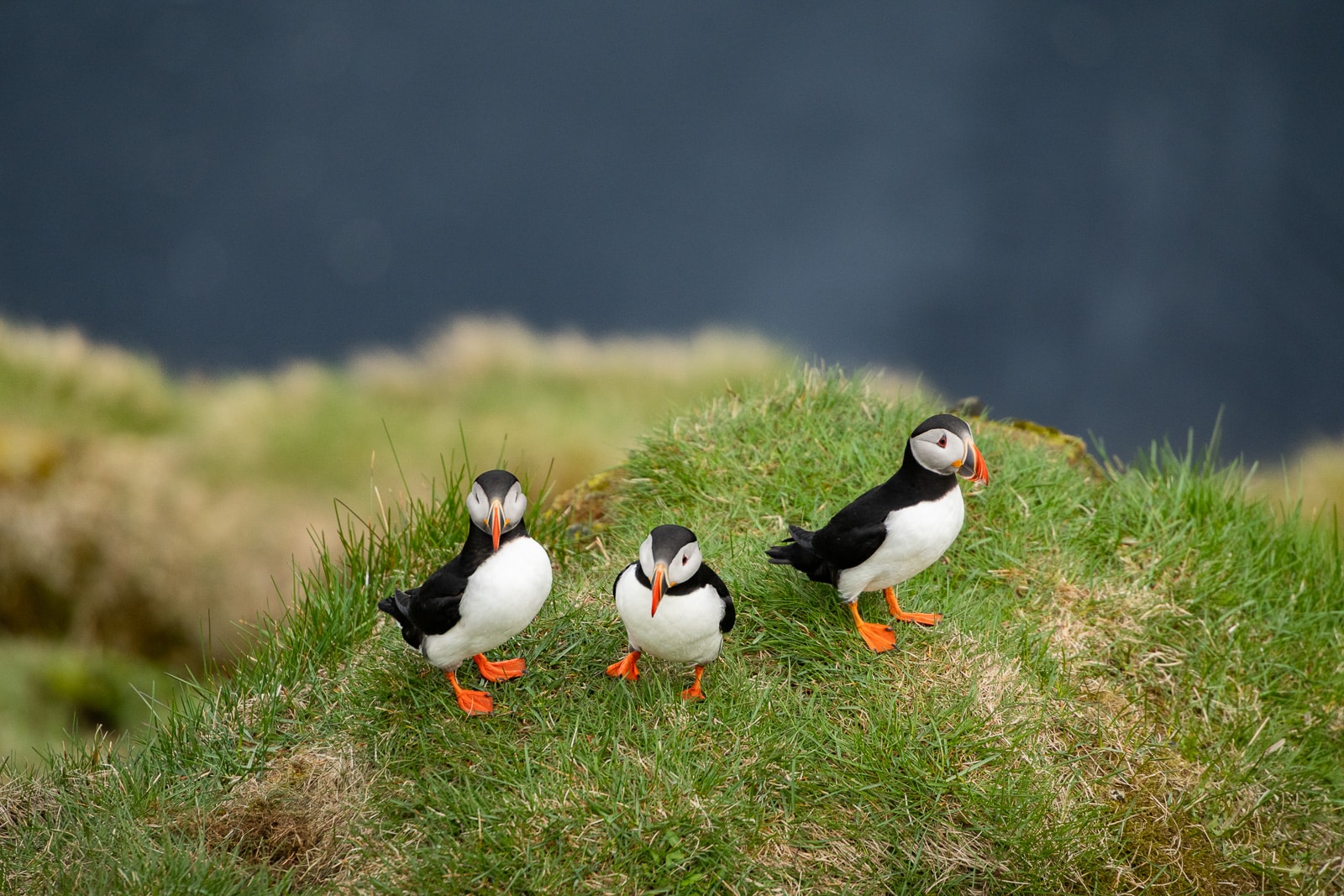
A few useful things to know about puffins before you go
The Atlantic puffin, called lundi in Icelandic (plural lundar), is deeply embedded in the country’s culture. You’ll find this name in many place names, like Lundey.
Despite what photos might suggest, it’s a very small bird, between 26 and 29 cm tall and around 400 grams. Basically a pocket bird ! That scale is important to keep in mind when thinking about framing and gear. The word “cute” should come out of your mouth approximately 94245 times while watching them 😉
Puffins are also fascinating in their behaviour. They’re monogamous and return to the same burrow every year, digging into the ground at the top of the cliffs, to mate and raise a single chick. They choose one partner for life. Unlike other seabirds, they don’t nest on bare rock but in the grass.
When it comes to feeding, they’re excellent divers, capable of reaching depths of up to 60 metres. And impressively, they can carry several fish in their beak at once, sometimes up to ten. That shot of a puffin with a beak full of fish is one of the most sought-after images in wildlife photography (my big dream, which I’m hoping to finally get this summer !).
It’s also worth noting that the Atlantic puffin is now classified as a vulnerable species by the IUCN. Its population is declining worldwide, including in Iceland. The main causes are linked to the decreasing availability of food, particularly small fish like sand eels, whose stocks are falling due to ocean warming and overfishing. This is why observing and photographing puffins should always be done with care and respect. Every behaviour matters, especially during the breeding season when the birds are particularly vulnerable.
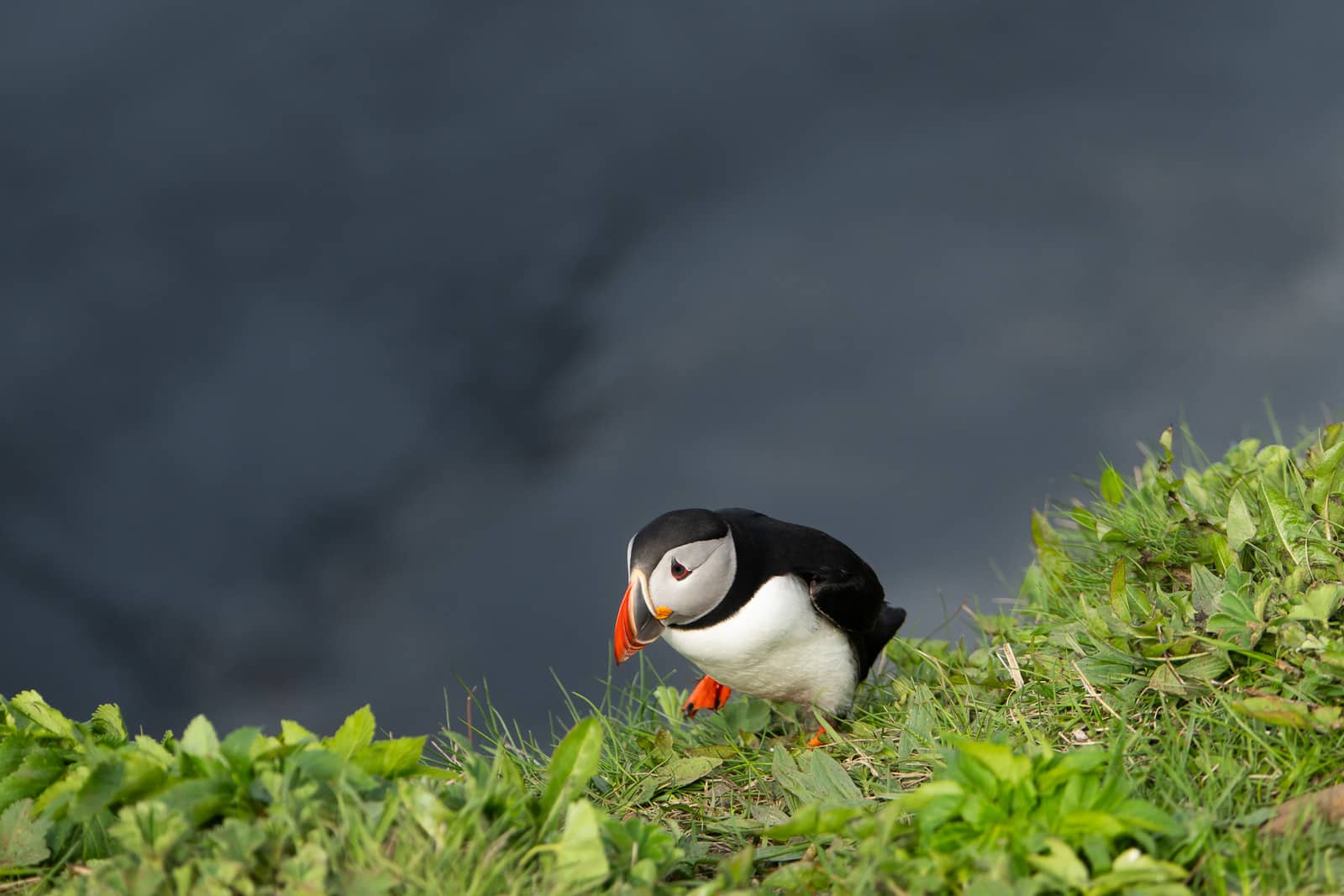
When to go and photograph puffins in Iceland
Puffins are in Iceland from mid/end-April to mid-August. Outside this period, they live at sea and are virtually impossible to spot. The best time for photography is June to July. That’s when the adults are feeding their chicks, making constant back-and-forth trips between the sea and their burrow, often with a beak full of fish. It’s the ideal window for capturing incredible action shots.
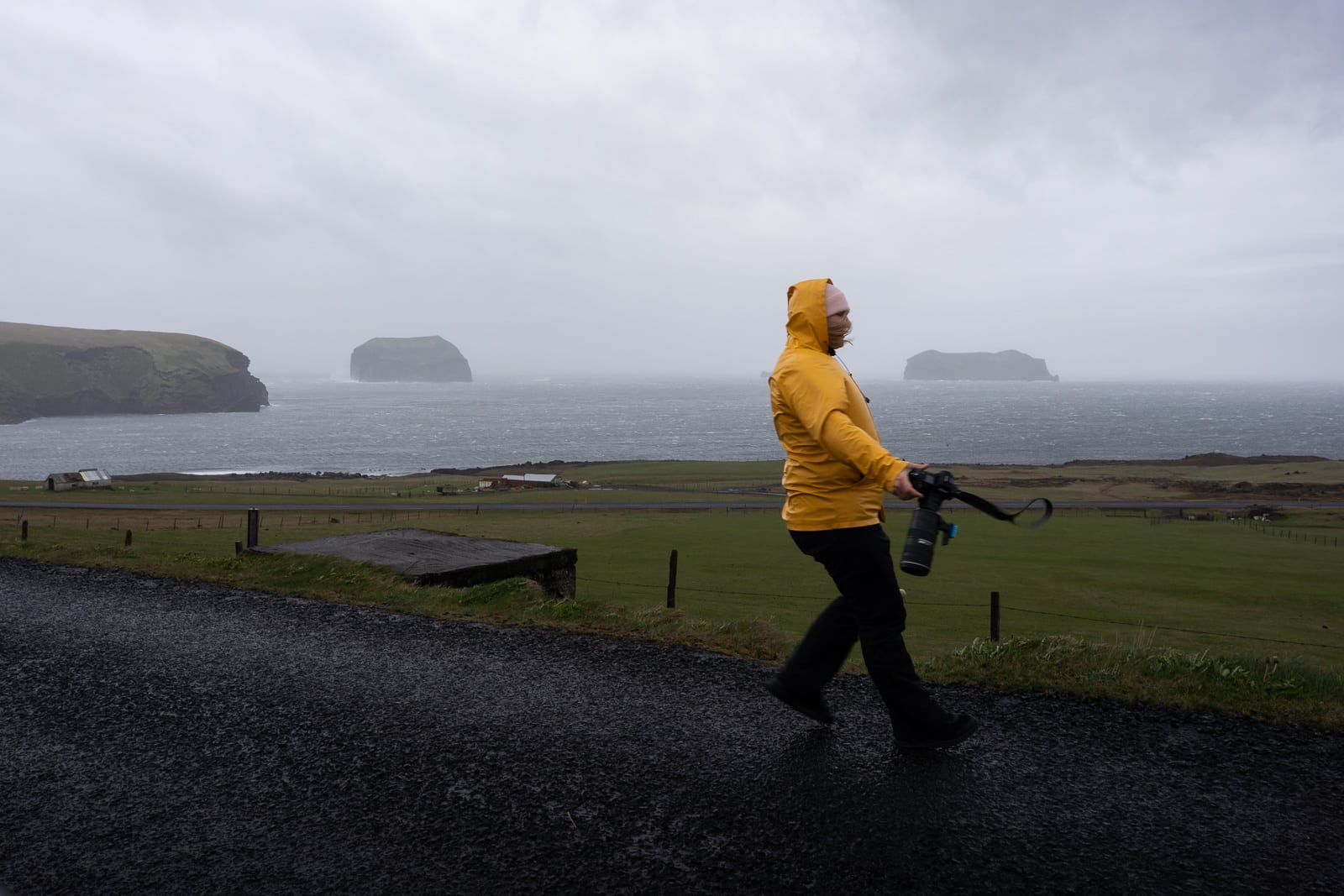
☀️ One thing that’s often overlooked is the weather. On sunny days, puffins spend a large part of the day at sea. When the sky is overcast, they tend to stay on land more. Those slightly grey days often offer the best photo opportunities. That said, if conditions are rough (think storm, heavy rain or thunder), they’ll stay in their burrows (and so will you, theoretically 😉), so there’s pretty much no point trying to photograph them. I went to the Vestmann Islands during a storm and only saw 2 or 3 puffins, when under normal conditions you would see them by the hundreds.
For timing, go for early morning or late in the day. The light is softer, there are fewer people, and the birds are more active, because they leave to feed their chicks. You’ll see them flying in and out of their burrows.
👉 If you’re planning to photograph them at Dyrhólaey : the site is closed between May 1st and June 25th from 7PM to 9AM to protect nesting. The rangers will ask you to leave, but it makes sense, the puffins need to breed in peace.
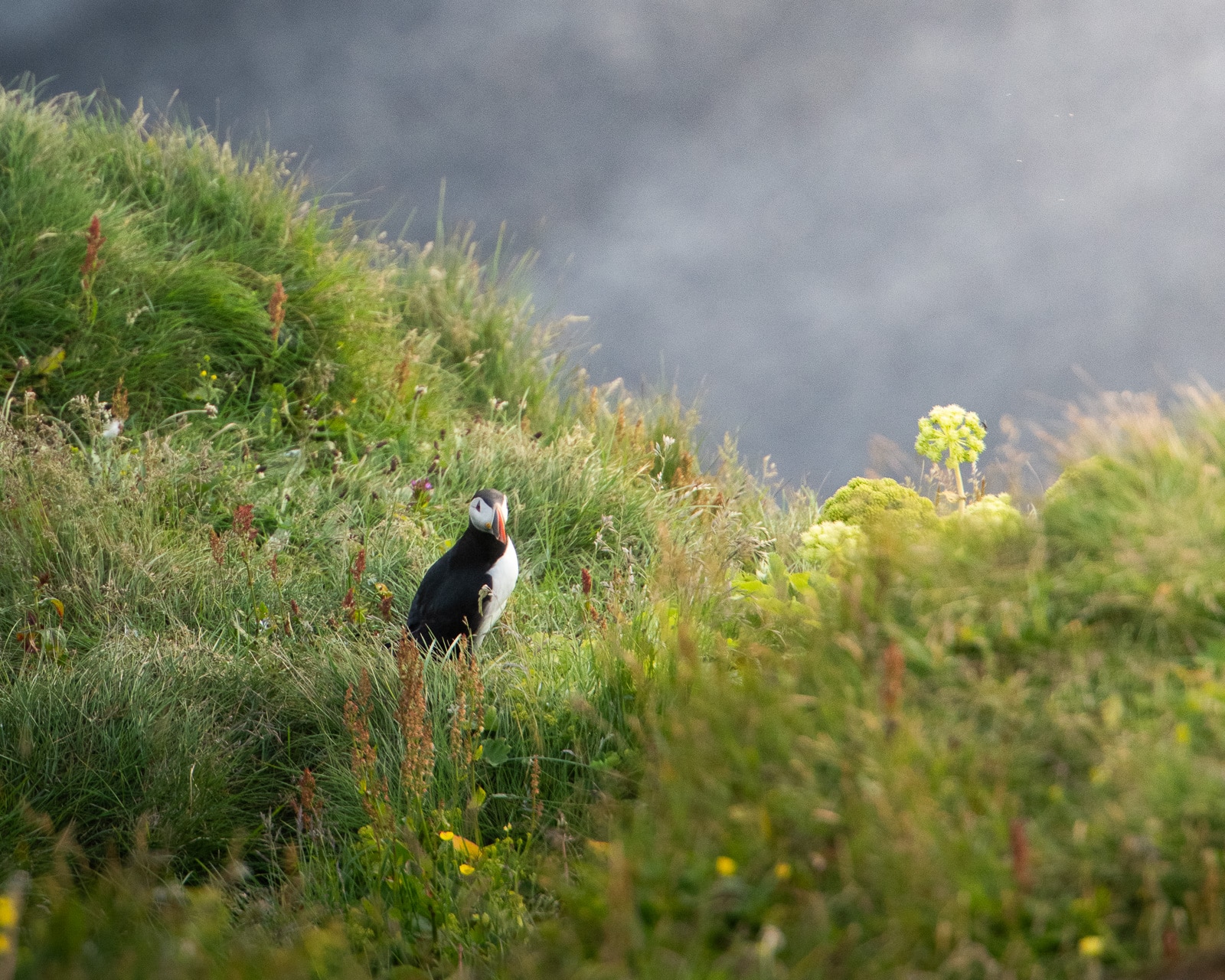
The best spots to photograph puffins in Iceland
Puffins can be found all around Iceland, but some places offer particularly good conditions for both observation and photography.
Látrabjarg (Westfjords) : one of my favorite spots
Látrabjarg is often considered the best spot to photograph puffins in Iceland. These impressive cliffs stretch for 14 kilometres and reach over 400 meters high. The atmosphere is raw, wild and completely isolated. To get there you drive along road 612, a bumpy mountain track with potholes, gravel and some good bends. You need to drive slowly in a proper 4WD and allow plenty of time, as the site is about 6 hours from Reykjavík. Puffins have to be earned!
Here, puffins nest directly in the grass right at the cliff edge. There’s no platform or hard barrier. You can literally end up a few centimetres away from them, at eye level. It’s an exceptional place, but it demands real care. If you lean too far over the edge, a 400m drop onto sharp rocks and a potentially wild ocean is waiting for you with no way back.
👉 I went there for the first time in July 2025, and it was an absolute JOY to experience the midnight sun at this spot. It was my very first stop of the trip, half sunny, half overcast, so there were loads of puffins out. I stayed from 11PM to 4AM just watching them, a genuinely intimate moment since there were only three of us on the cliffs (my friends and me). My friend JessReporter, who’s a wildlife photographer, had stars in her eyes ! The puffins are just centimeters from the rope that serves as a barrier. A telephoto lens is almost unnecessary here.
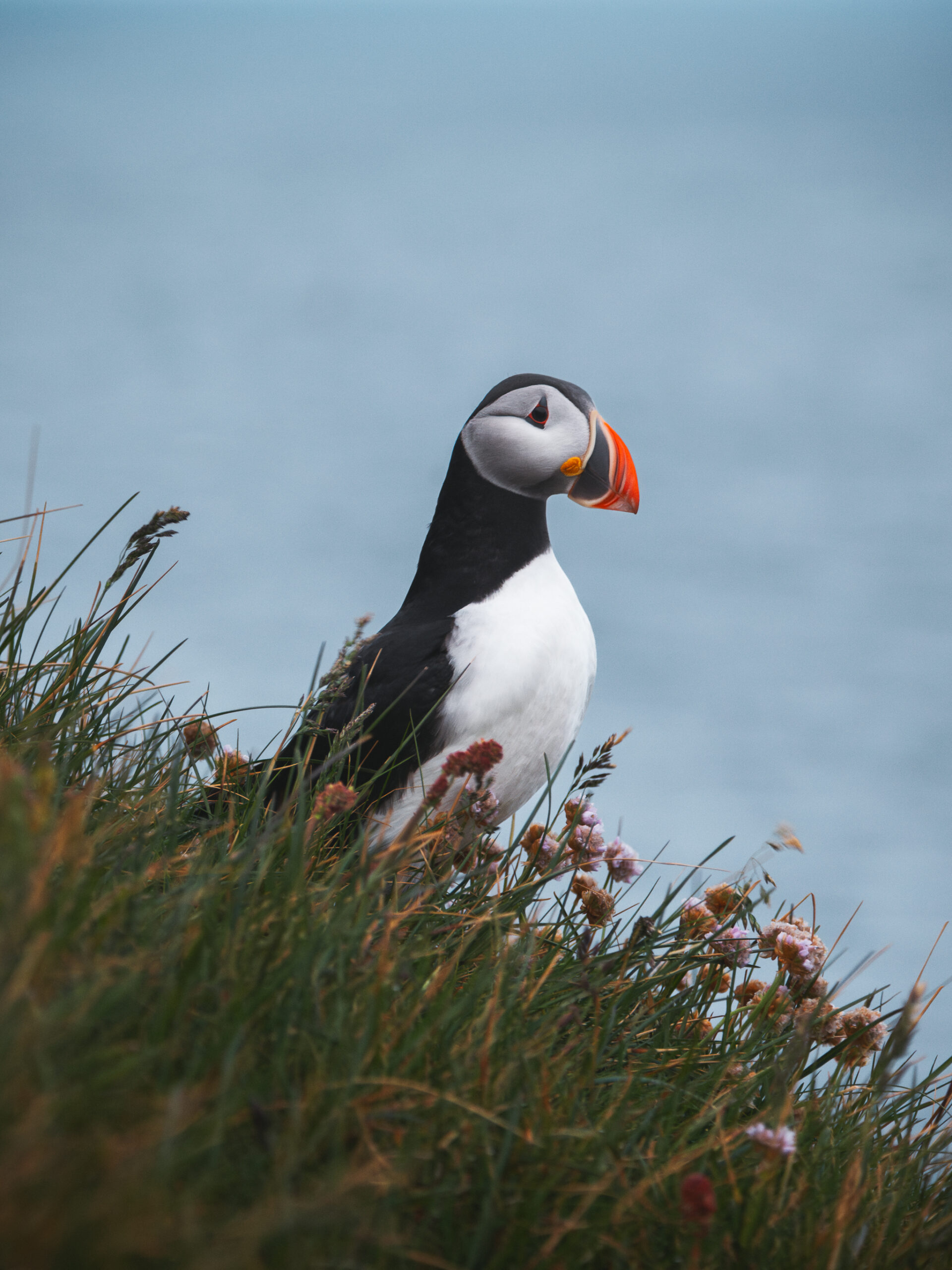

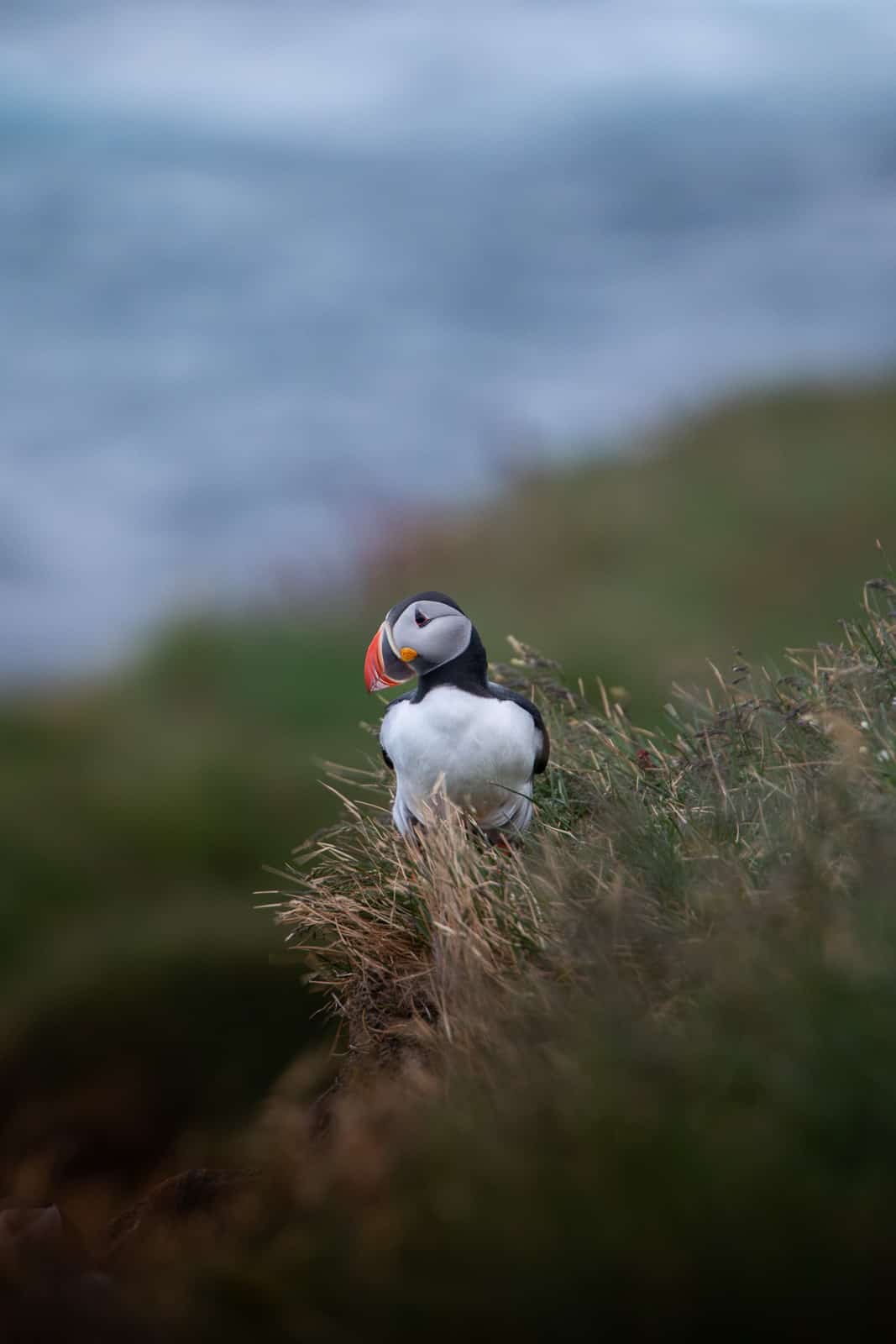
Borgarfjörður Eystri : puffins in the East Fjords
This is apparently the most comfortable spot for photographers. At Hafnarhólmi, wooden platforms have been built at bird level. You can observe and photograph puffins at virtually minimum distance, with no real effort and without disturbing the colony.
There are around 10000 nesting pairs here, in a much calmer atmosphere than the more famous spots. Access is from Egilsstaðir, about 1 hour away. The road is now fully paved but crosses a spectacular mountain pass. Entry is free, but you can make a donation here.
👉 I haven’t been yet, but it’s the first place I’m heading to as soon as I arrive in Iceland ☺️ I’ve planned it as the very first thing I do after getting off the ferry, going to see the puffins at Borgarfjörður Eystri. I’ll report back !
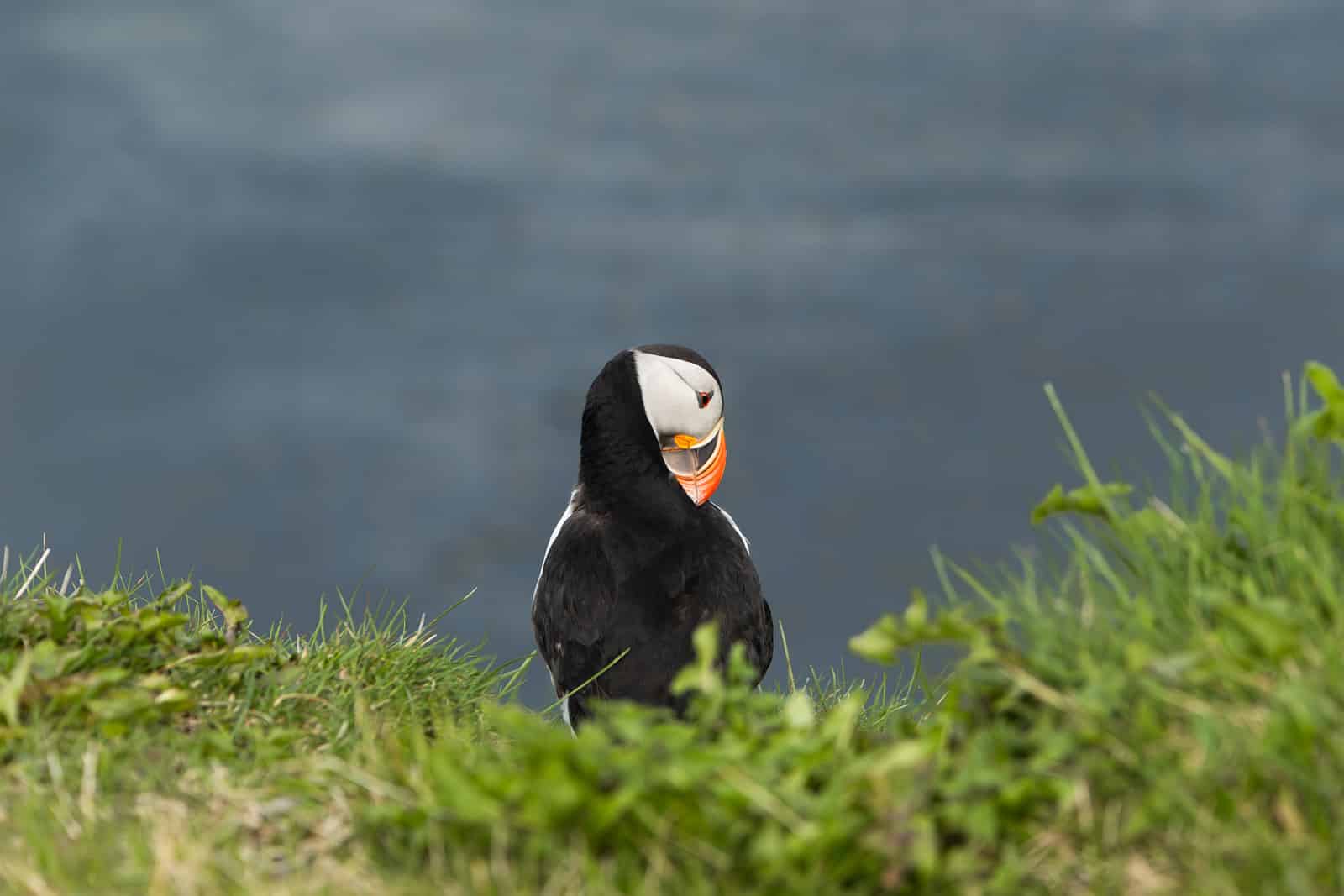
Heimaey in the Vestmann Islands : the largest puffin colony in the world
Vestmann Islands are home to the world’s largest puffin colony, with between 2 and 4 million individuals, around 20% of the global population. Heimaey is the main island and you can access it by ferry from Landeyjarhöfn in 30 minutes, or by plane from Reykjavík.
The best viewpoint is here. The density of birds is impressive (on paper) and there’s even a bird-watching post where you can sit and watch them. If you can, stay a night on the island in summer. The evening and morning light completely transforms the atmosphere.
👉 I have unfinished business at the Vestmann Islands, the last time I went in 2024, Iceland got hit by a massive storm that stopped me from enjoying not only the puffins (they were hidden) but the rest of the island too. We’ll see what this summer brings, but the spot is fantastic for watching them and really well set up !
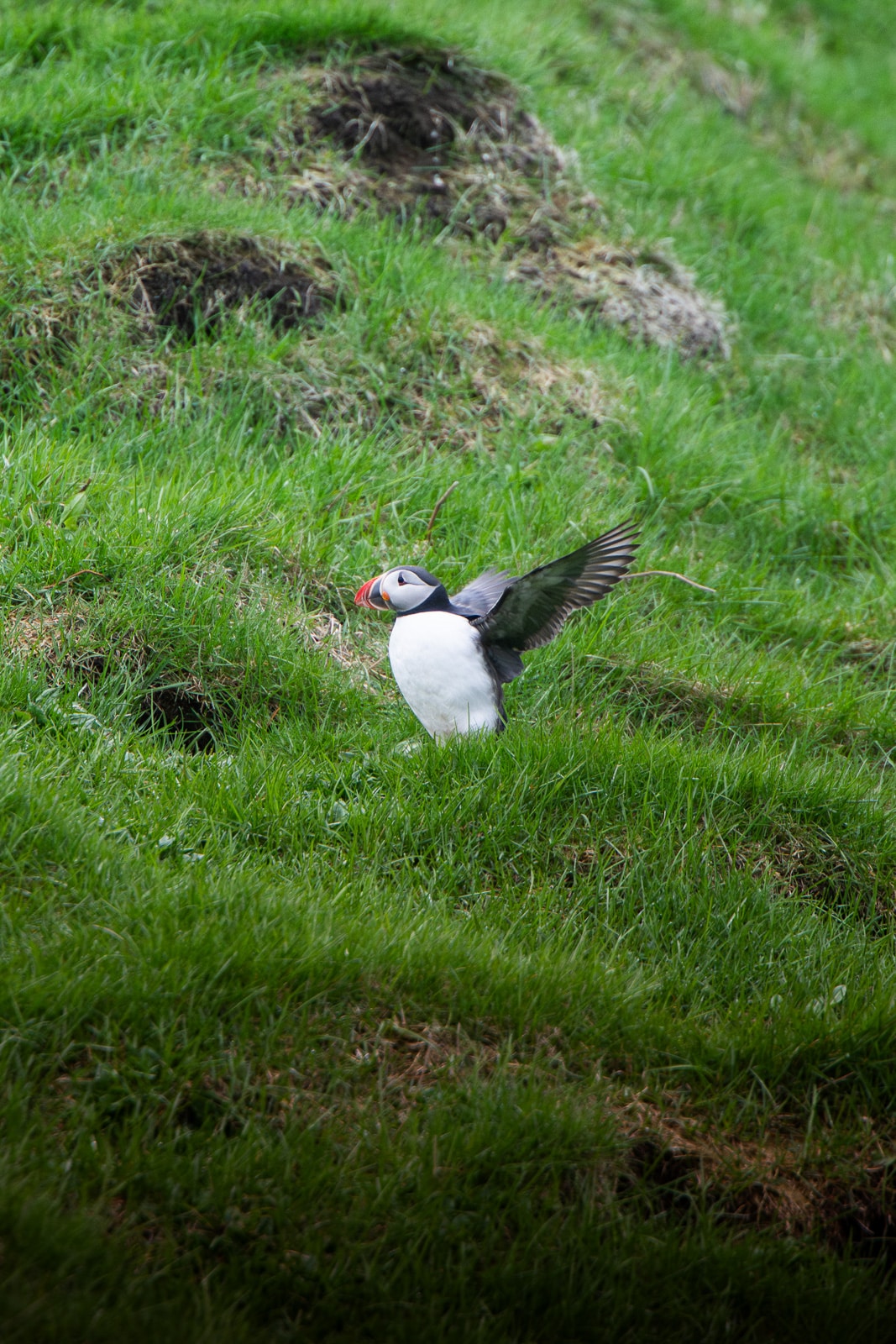
Dyrhólaey : puffins in the south, near Vík
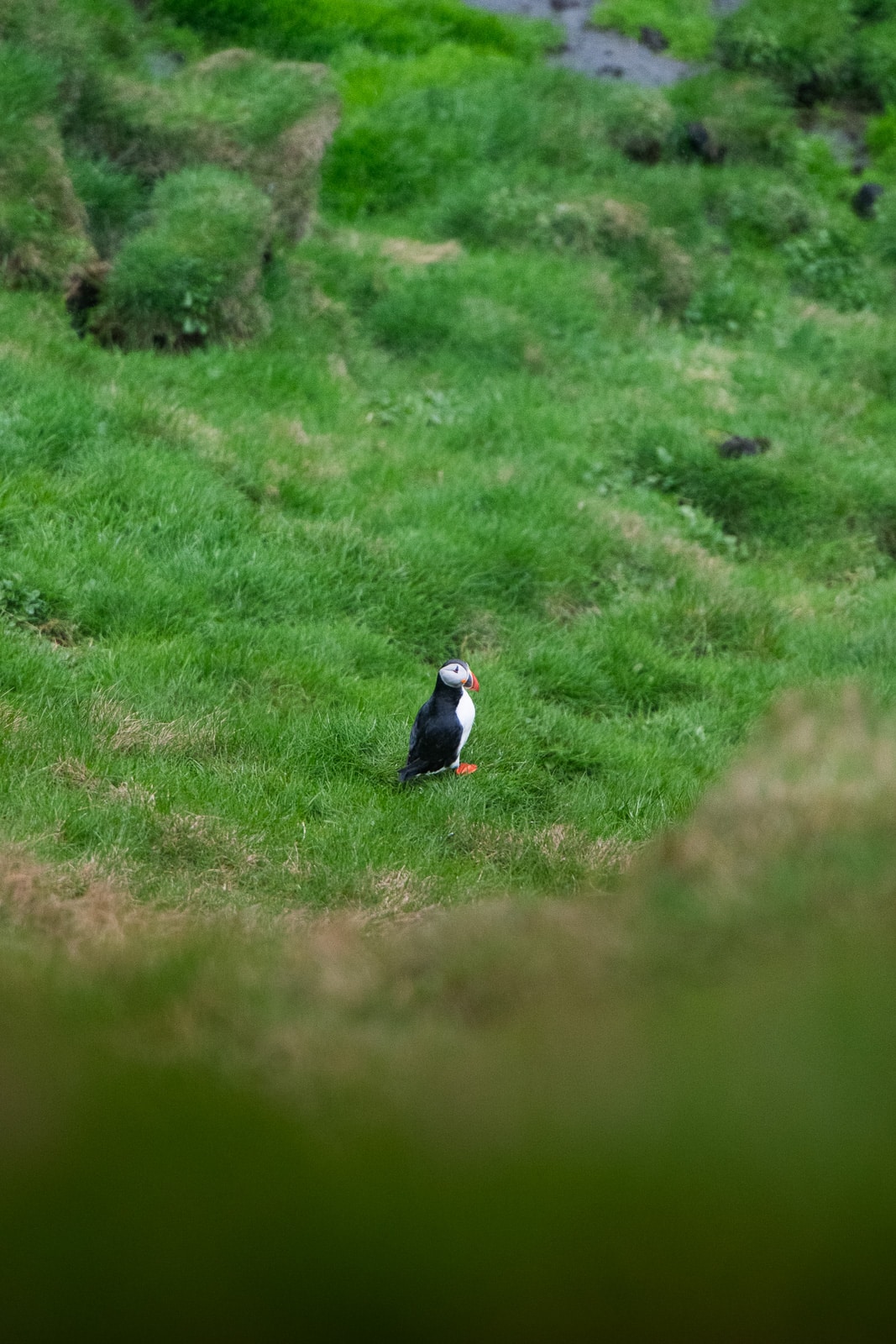
The most accessible spot from Reykjavík, about 2.5 hours by road. At Dyrhólaey you’ll find a beautiful large rock arch with an open view over the black sand beaches and glaciers in the distance. Puffins nest up high, which makes it a perfect spot for them.
As I mentioned above, Dyrhólaey is closed from May 1st to June 25th between 7PM and 9AM to let the puffins breed undisturbed. Factor that into your itinerary planning in summer.
👉 The first time I went to Dyrhólaey was in late May, so I had to work around the time restrictions. I went at 9AM and there were LOADS of puffins, it was a fairly sunny day. Some are very close to the barriers, others nest further away, so make sure you bring a telephoto. My later visits were in July with no time restrictions, so I was able to go at night hoping for a nice sunset, but the sky was pretty overcast.

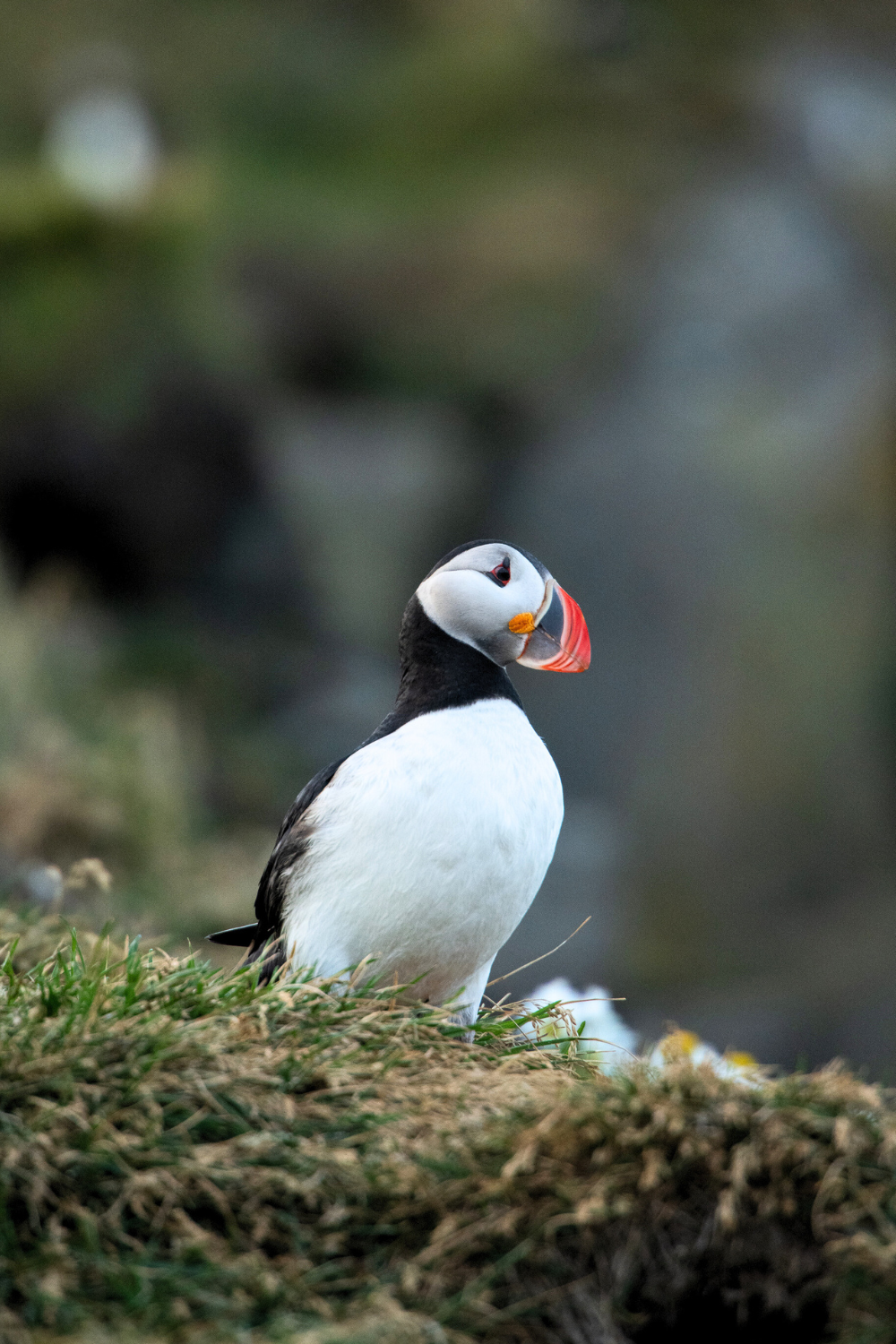
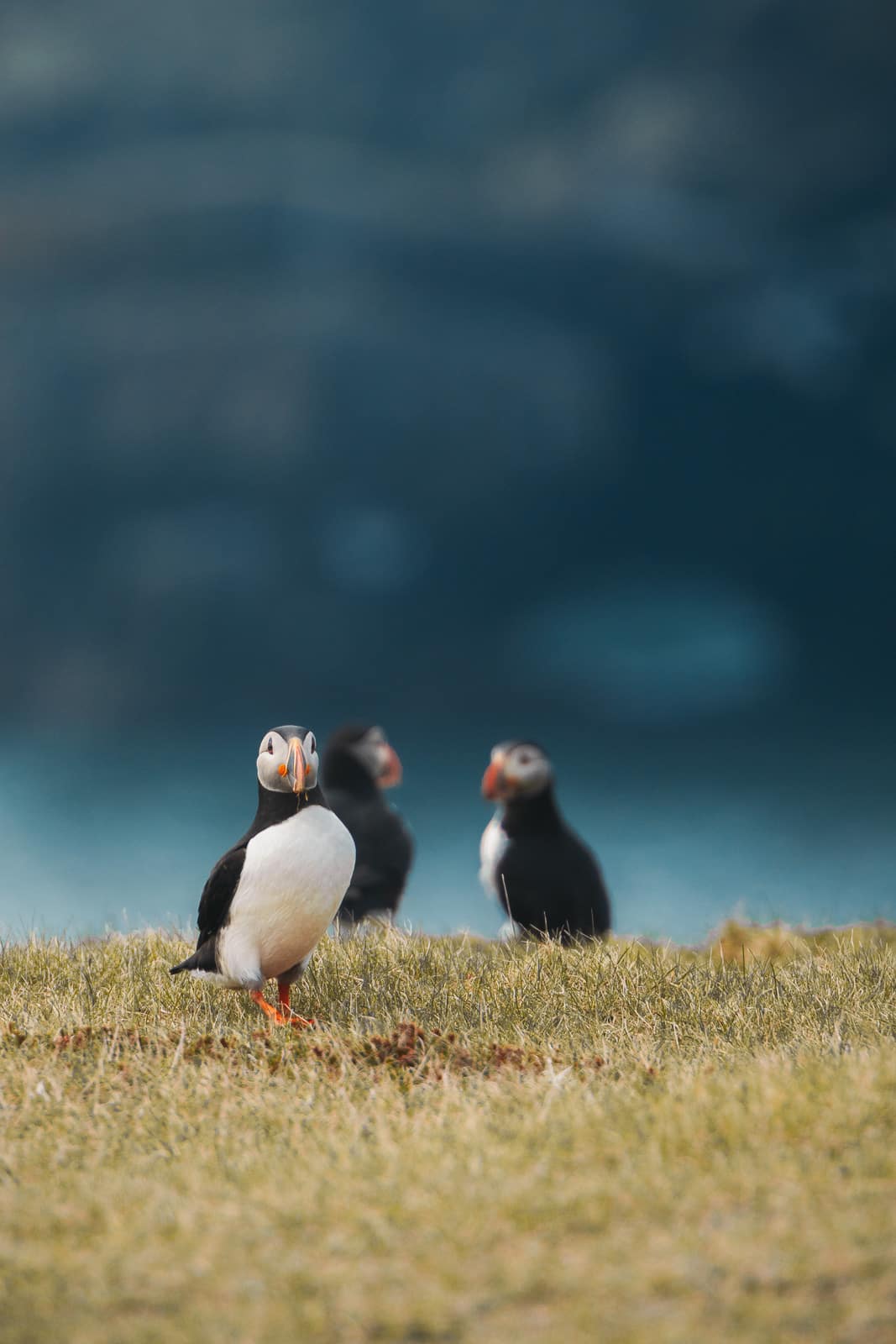
Grímsey island : beyond the Arctic Circle
Grímsey is the only Icelandic island located beyond the Arctic Circle. It has barely 50 inhabitants, you don’t need a car to get around, and you literally cross the Arctic Circle! It offers a much more remote experience. You can reach the island either :
- By ferry : three times a week, a boat runs between the town of Dalvík and Grímsey. It departs at 9AM, the crossing takes 3 hours and costs around 8800ISK return (61€). The ferry stays on the island for between 2 and 5 hours before heading back to Dalvík. In my opinion, unless you’re really rushed by time, it’s not worth a 6-hour round trip for less than 5 hours on the island. You can book the crossing here (book ahead in summer, the boat isn’t very big).
- By plane : the airline Norlandair operates a flight from Akureyri to Grímsey year-round, 5 times a week in July and August, and 3 times a week (Wednesday, Friday and Saturday) the rest of the year. The flight takes 30 minutes and stays on the island for 1h30. It costs around 260€ return and you can book it here.
Puffins arrive early in the season on Grímsey, and the lack of crowds makes for a very immersive experience. It’s a great option if you want to combine wildlife photography with the symbolic crossing of the Arctic Circle. You can buy a small certificate proving you crossed it at the shop on the island.
👉 This is also one of the first places I’m going this summer, right around the summer solstice. Fingers crossed for good weather and lots of puffins to photograph ! I’ll update this article with my experience.
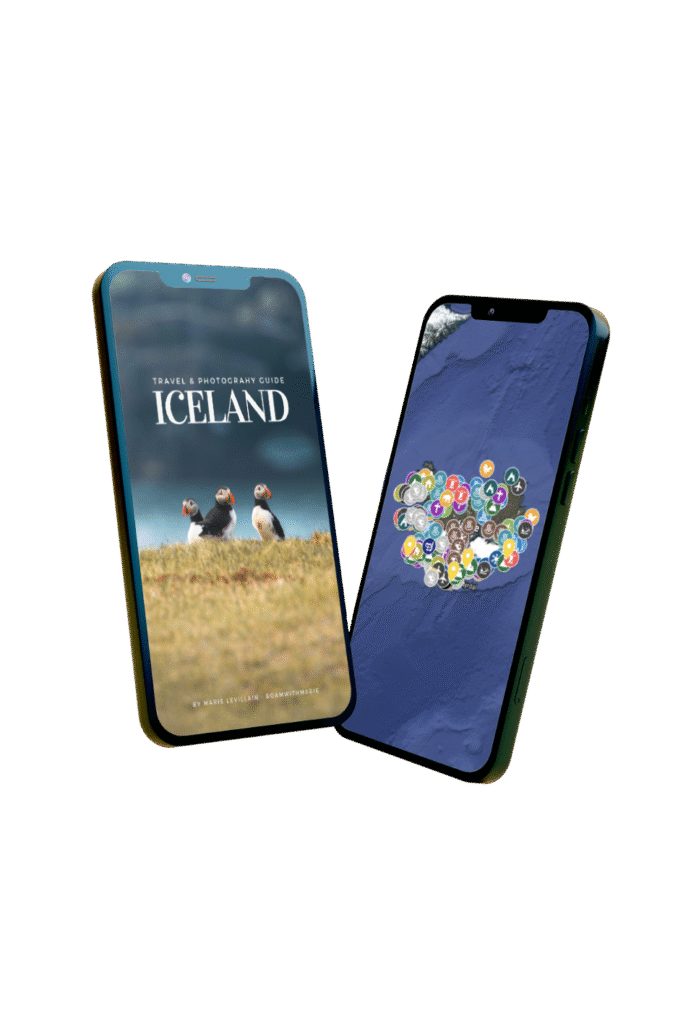
That’s exactly why I created my Iceland Photography Map, to help you discover off-the-beaten paths places, with less crowds and more interesting experiences. It includes over 400 photo spots spread across the entire island. In the description of each location, you’ll find :
- access information
- the best light conditions
- what gear to bring
- where to park and how much it costs
- the best season to visit
- useful links
Each spot also comes with my own photography tips and composition ideas. No more wasting hours cross-checking scattered and sometimes inaccurate information found online !
What gear do you need to photograph puffins ?
Photographing puffins doesn’t necessarily require a lot of equipment, but a few things do make a real difference :
🔍 A telephoto lens is essential for me. A minimum of 200mm is recommended, but the sweet spot is between 400 and 500mm. That said, at some spots like Borgarfjörður Eystri or even Látrabjarg, the birds are so close that a 100mm can be enough for lifestyle shots. If you want portraits though, you’ll need a telephoto lens.
📷 The camera body plays a key role, especially for flight shots. Fast and accurate autofocus is essential, but most recent mirrorless cameras perform really well on this kind of subject.
🔭 A tripod can be useful for long sessions, like to rest your arms or frame a scene and wait for the moment, but the majority of shots are handheld, especially when following birds in flight.
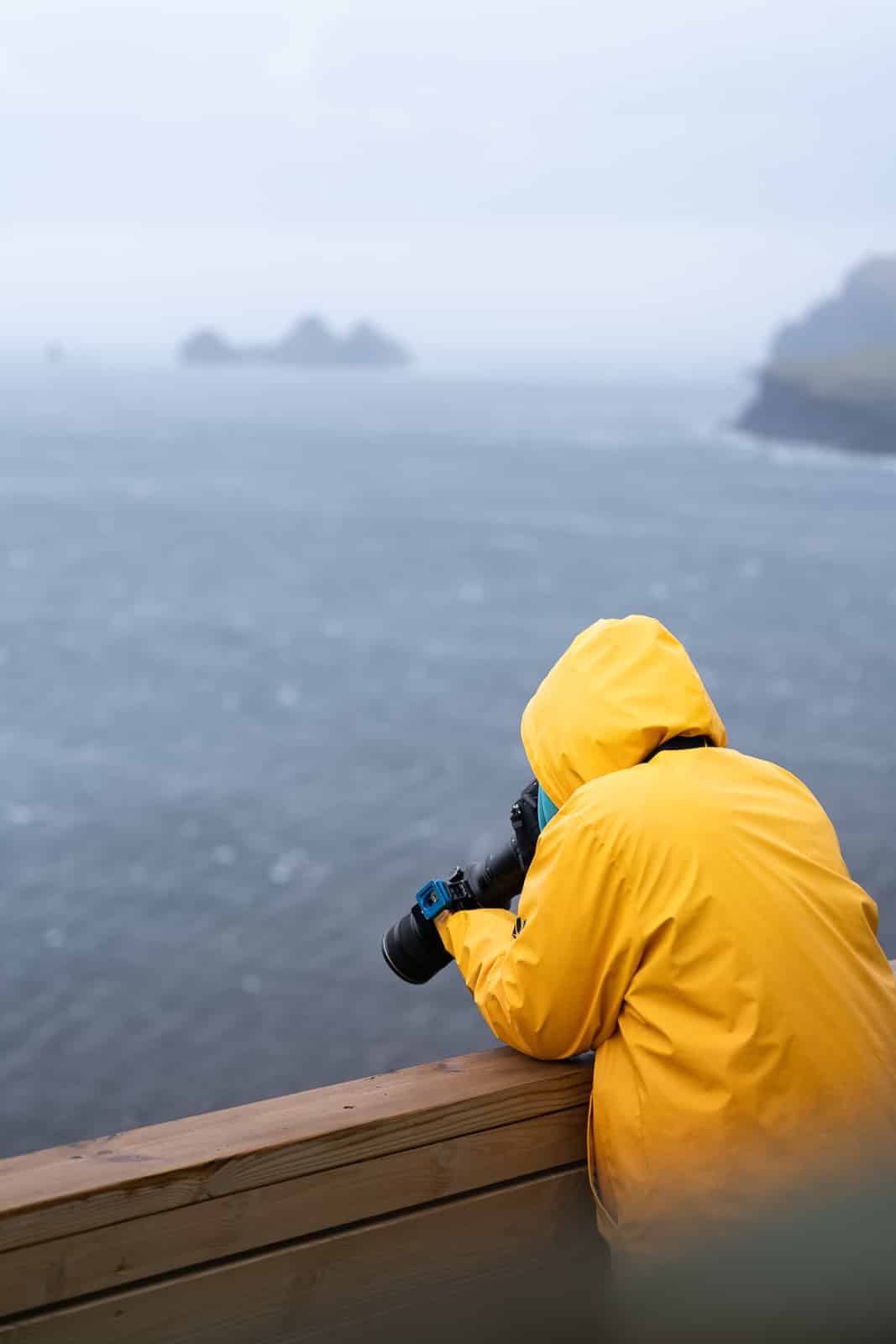
☔️ Don’t overlook the weather conditions and dress accordingly. Pack waterproofs and windproofs, like this jacket from Alpine Nation, and above all, protection for your gear. You can have a look at everything I carry in my bag right here. The day at the Vestmann Islands when I thought the sky was going to fall on my head, I was very glad to have water-resistant gear.
Camera settings for puffins
Puffins on the ground
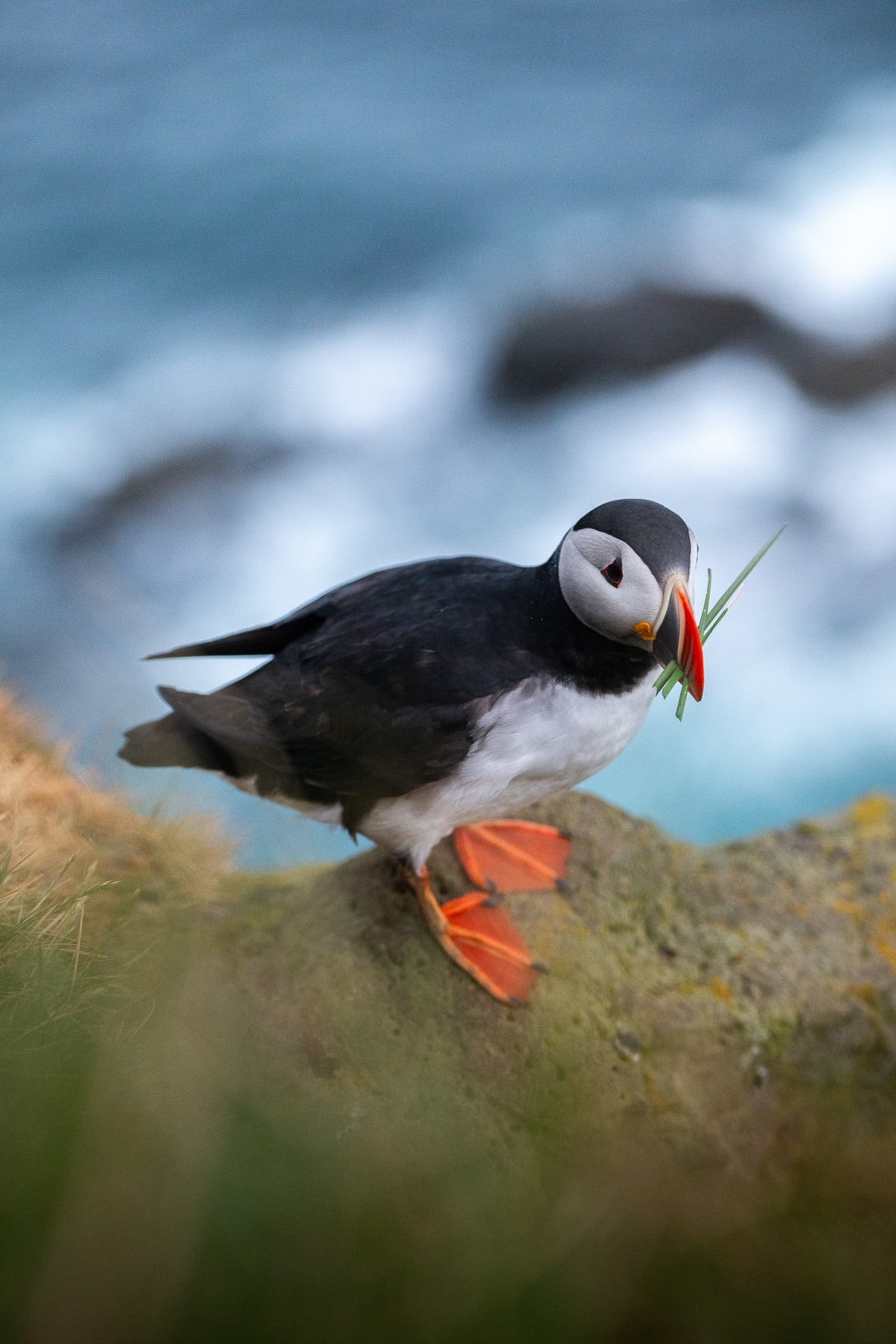
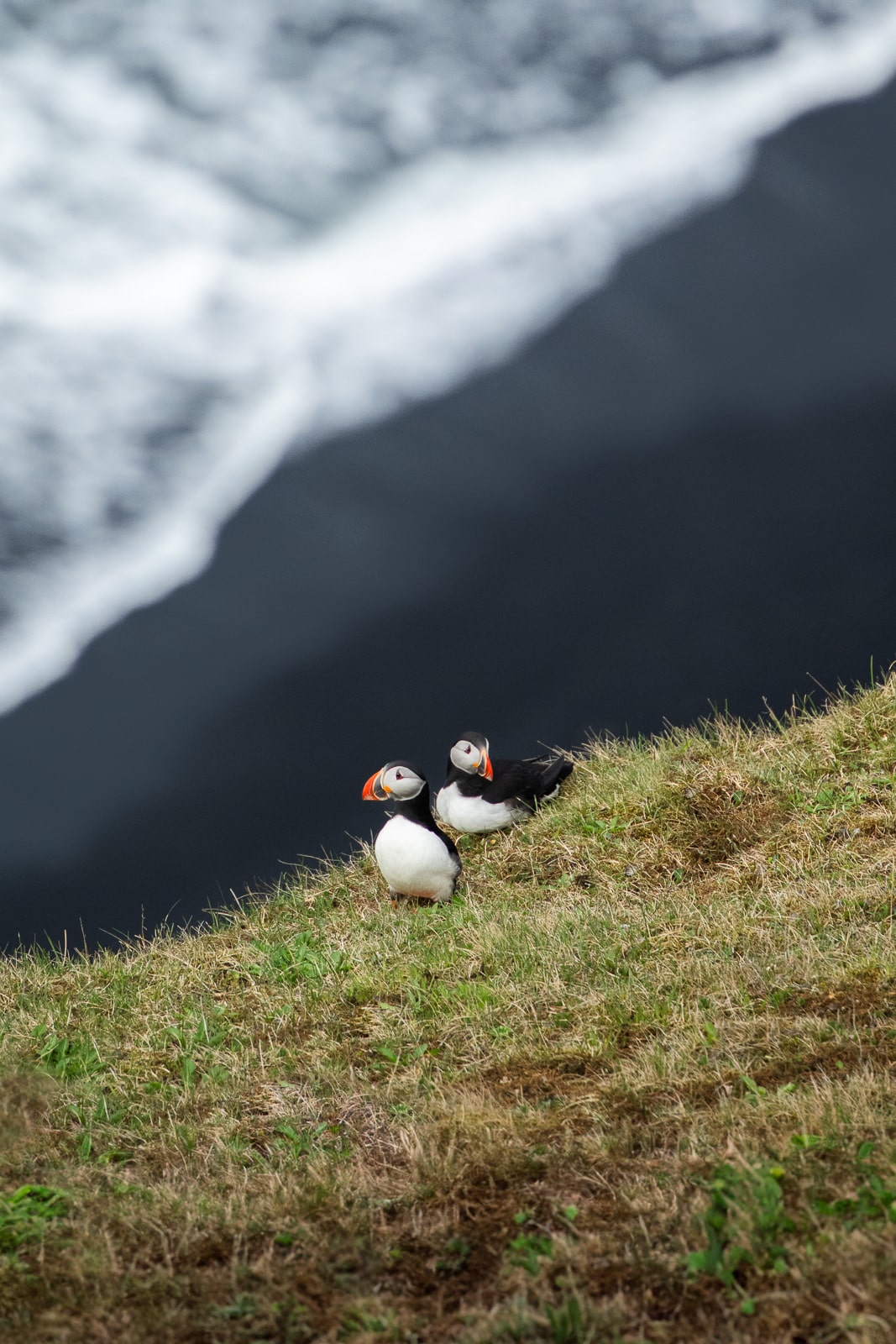
When puffins are on the ground they waddle around from point A to point B, and they’re fairly easy to photograph :
- Shoot in aperture priority or manual mode, with a value between f/4 and f/8. This keeps the subject sharp while retaining a little context. At f/2.8, if you’re too close, the puffin won’t be entirely in focus.
- A shutter speed of at least 1/500s is recommended to avoid blur from their micro-movements
- ISO can stay moderate, generally between 400 and 800 depending on the available light.
This is the perfect moment to work on your composition. Puffins are fairly calm on the ground, so you can take the time to observe and adjust your framing. Burst mode is unnecessary in my opinion, unless you enjoy sorting through 15 identical shots (which I absolutely did at the beginning).
Puffins in flight
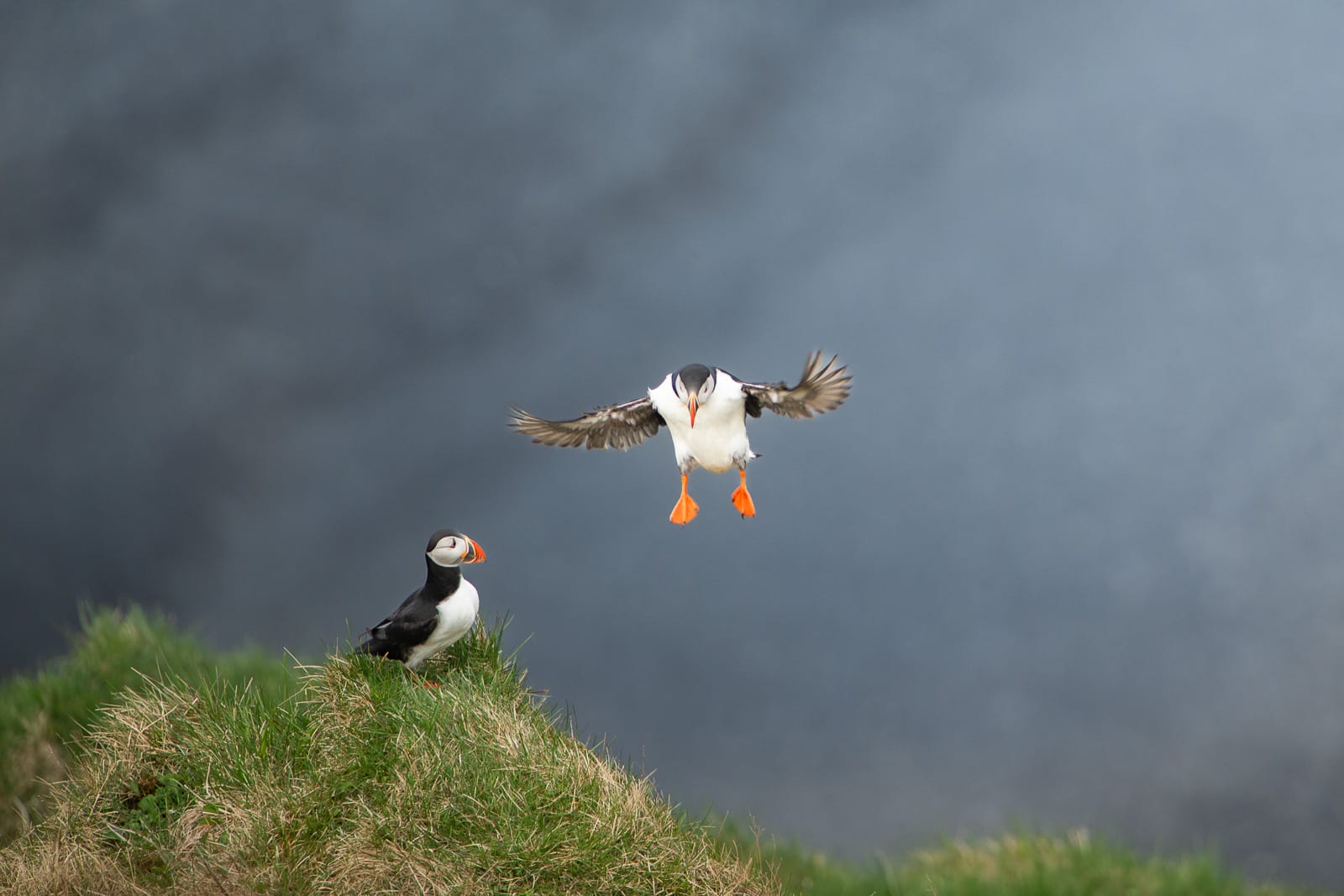
Now we’re getting into the hard stuff 😅 This is clearly the most technically challenging part, as puffins fly fast with unpredictable changes of direction. You need to adjust your settings accordingly.
- Switch to shutter priority or manual mode, with a minimum of 1/2000s, ideally 1/3200s to freeze the wings.
- Use auto ISO with an upper limit of around 3200 max depending on your camera.
- Enable continuous autofocus with subject tracking and switch to burst mode. This is the moment to hold down that shutter!
👉 One important tip : anticipate. Puffins often follow the same flight paths when returning to their burrows. Positioning yourself correctly will dramatically increase your chances of getting the shot. You’ll notice they beat their wings incredibly fast, because they’re tiny.
My field photography tips
Out in the field, technique isn’t everything. It’s often the small details that make the difference, and above all, the way you interact with your environment :
🧘♀️ Patience is essential. Get settled, observe, wait (I would recommend the same approach for landscape photography too, take 5 minutes without the camera before you start shooting). Puffins eventually get used to your presence if you stay calm and still. After a few minutes you’ll notice they go back to completely natural behaviour. That’s when the really interesting images happen.
🐟 Look for feeding scenes. A puffin with a beak full of fish is a signature shot and a hard one to get. In July, the adults are constantly going back and forth between the sea and their burrow, so if you identify an active area, take the time to position yourself well and wait. Often the best shots come after 20 or 30 minutes, not in the first few seconds.
🐧 Try to anticipate. Puffins are creatures of habits : they tend to use the same flight paths to return to their burrow. Once you’ve identified these “corridors”, position yourself accordingly and prepare your composition in advance.
👁️ Vary your compositions. Don’t just go for tight portraits (they’re great, I’m not saying otherwise). Include the environment, play with the lines of the cliffs, use the grass as a foreground, experiment with backlit shots or wider framings. Bringing in natural elements gives your photos much more context !
☀️ Use the midnight sun to your advantage. In summer, between 9PM and midnight, the light becomes soft, it picks out the textures of the black and white plumage and makes the colors of the beak pop. The grass loses the weird vivid Iceland yellowish color and becomes softer, the background can turn orange, there are less people around… Golden hour is genuinely a great time to photograph them, especially since they tend to be more active then!
Ethical guidelines: photographing puffins without disturbing them
Photographing puffins comes with real responsibility, especially in Iceland where tourist pressure increases every year. I’m far from an expert on the subject, I’m not a naturalist or a bird specialist in any way, but I believe all animals deserve respect. For some people the following will seem like obvious rules to follow around any wild animal, but there’s stuff that I’ve seen, read or picked up over time that need to be said :
👣 The most important point is the burrows. Puffins nest in tunnels dug into the grass, which are often completely invisible. Walking off the marked paths can literally crush a nest without you ever realising. That’s why it’s essential to stay in the designated areas, even if it sometimes limits your shooting angles. Don’t hesitate to say something to people who step over barriers, yes, you might sound like a Karen, but the animals need protecting. And walking on cliff edges is just dangerous anyway, wtf ??
👁️ Another key point is how close you get to the nests. When a puffin returns with fish, it needs to be able to reach its burrow quickly to feed its chick. If you’re too close, it may hesitate, circle around, or temporarily abandon the attempt. Repeat that a few times and you could compromise the survival of its baby. A good rule is to limit your time in a sensitive area to a few minutes, then move on.
📏 Distance is a simple indicator. If a bird moves away, gets agitated, or changes its behaviour because of you, you’re already too close. In that case, back off immediately. You might not have the gear to get tight portraits, but it’s better to let go of a shot than to potentially impact the already fragile life of an endangered bird.
🚁 Same goes for drones, which can cause panic reactions across entire colonies. Don’t fly near nesting sites, there should be a “no drone zone” sign in theory, but the absence of a sign doesn’t mean you can go do loops with your FPV.
🍫 Avoid any attempt at interaction. Never try to attract a bird, feed it, or provoke a reaction to get a photo. Aside from being harmful, it usually produces artificial and boring images anyway.
👉 Finally, keep the bigger picture in mind. The Atlantic puffin is a declining species facing increasingly difficult environmental conditions. As a photographer, you have a role to play, not just as a witness, but as a protector. No photo is ever worth stressing or endangering an animal.
FAQ : photographing puffins in Iceland
When can you see puffins in Iceland ?
Puffins are present in Iceland from mid-April to mid-August. The best time to photograph them is June-July, when adults are actively feeding their chicks and are very present on the cliffs.
What lens do you need to photograph puffins in Iceland ?
At purpose-built spots like Borgarfjörður Eystri or Látrabjarg, a 100-400mm is more than enough, the birds are sometimes less than 2 meters away. For puffins in flight, a 400-500mm and a shutter speed of at least 1/3000s are recommended.
Can you photograph puffins for free in Iceland ?
Several sites are free or donation-based (Látrabjarg). Borgarfjörður Eystri (Hafnarhólmi) runs on a donation system and Dyrhólaey has a paid car park. Boat excursions from Reykjavík are paid (around 30-40€).
Are puffins dangerous or aggressive ?
NOOOO. Puffins are unbothered by calm humans. They can bite if you try to touch them though, which is never a good idea anyway, why would you touch wild animals ? They are the cutest birds on earth and you’ll desperately want to put one in your pocket and take it home, but please don’t touch them.
Can you see puffins in Iceland without a car ?
Yes, from Reykjavík by taking a boat excursion to the islands of Lundey or Akurey. For land-based sites like Látrabjarg or Borgarfjörður Eystri, a car (or organised tour) is essential.
Can you eat puffins ?
Technically yes, but it’s best to not do it. Puffins are a vulnerable species with declining populations, and eating it today is mostly linked to tourism. The vast majority of Icelanders don’t eat it anymore, so why would you ? Continuing to consume it, even occasionally, helps maintain a demand that really has no justification today. If you’re going to Iceland to observe and photograph them, the logic follows that you respect them, not put them on a plate.
Feel free to send me or tag me on Instagram with your puffin photos, I would love to see them ! Happy exploring 🐧
Marie