Walking on a glacier in Iceland isn’t just about “ticking off a bucketlist activity” on your itinerary, it means stepping into a living environment, constantly in motion, that can be just as fascinating as it is dangerous.
I had already seen glaciers from far, from the parking areas or with a drone, but never up close. So I was incredibly excited to finally discover this kind of landscape, I wanted to understand what actually happens on a glacier : how it forms, how it evolves and see what those famous ice caves and tunnels we see everywhere in photos really look like (spoiler, I wasn’t disappointed).
For complete transparency, this article was written as part of a collaboration with Local Guide, but my opinion genuinely reflects what I honestly think about this experience. In this article, I’m sharing how a guided glacier hike in Iceland actually works, what we saw, and for who this type of experience is really for. I’ve also put in a little surprise at the end of the article for your next trip to Iceland ❄️
Why I chose a small-group guided glacier tour in Iceland
Walking on a glacier in Iceland is not a basic experience. A glacier isn’t a frozen backdrop or a playground for photographers. A glacier is a living environment, constantly moving, with its own rules, and you feel that as soon as you get close to it. Standing in front of tons of ice and realizing that you’re about to walk on it is incredibly impressive.
What I was really looking for wasn’t just “doing another activity in Iceland” for the sake of doing an activity, but truly understanding what I was seeing. Learning how to read the terrain, recognize fragile areas, identify ice formations and above all understand how and why the glacier evolves. Without a guide, so many things would have completely gone unnoticed. And even after spending an entire afternoon asking a million questions, I still wouldn’t go onto a glacier alone even if I understood better where to walk and not to walk 😅
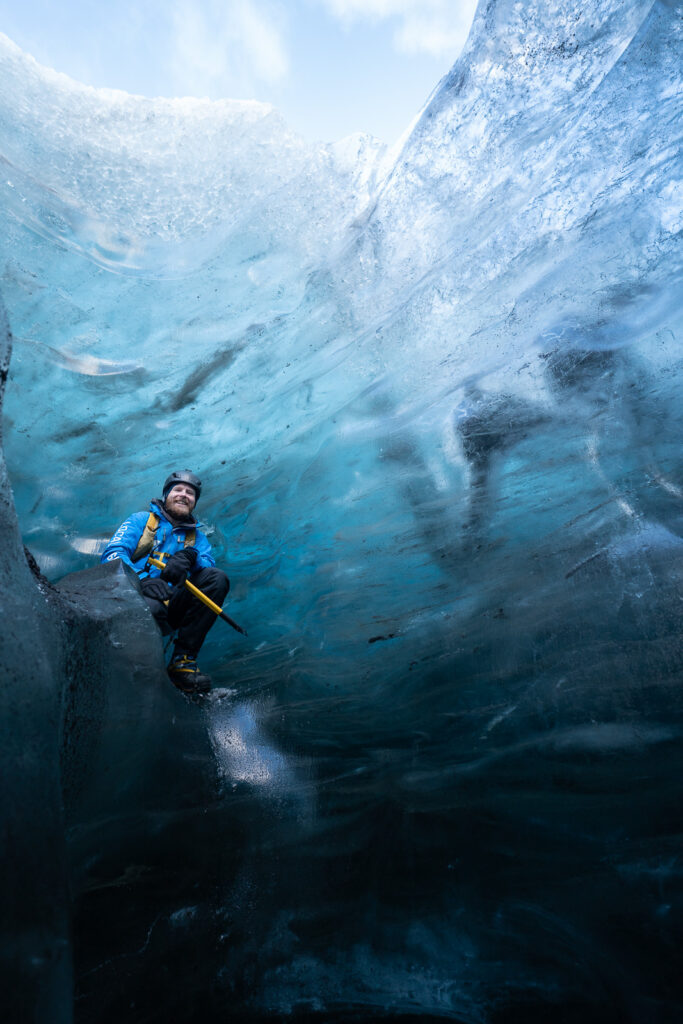
Our guide, Dan, played a central role in this experience. He didn’t just take us from point A to point B, he explained what was beneath our feet, how moulins form, why some ice caves exist for one season and disappear the next one, and how the glacier “breathes” depending on temperature and light. It was incredibly enriching, and you could really feel how passionate he is about his job and about glaciers.
Safety and initial apprehension
Despite the excitement, I was a bit nervous at first, like, “I’m really going to walk on a glacier ? Me ?? Who can barely take three steps without tripping ?” But everything went super smooth. Safety is obviously a constant focus, but never in a stressful or overwhelming way. Reading the terrain, checking safe passage areas, constantly adapting to the condition of the ice, the guide takes care of all of this and you could feel our guide’s complete control of the situation, which made it easy to relax and fully enjoy the experience.
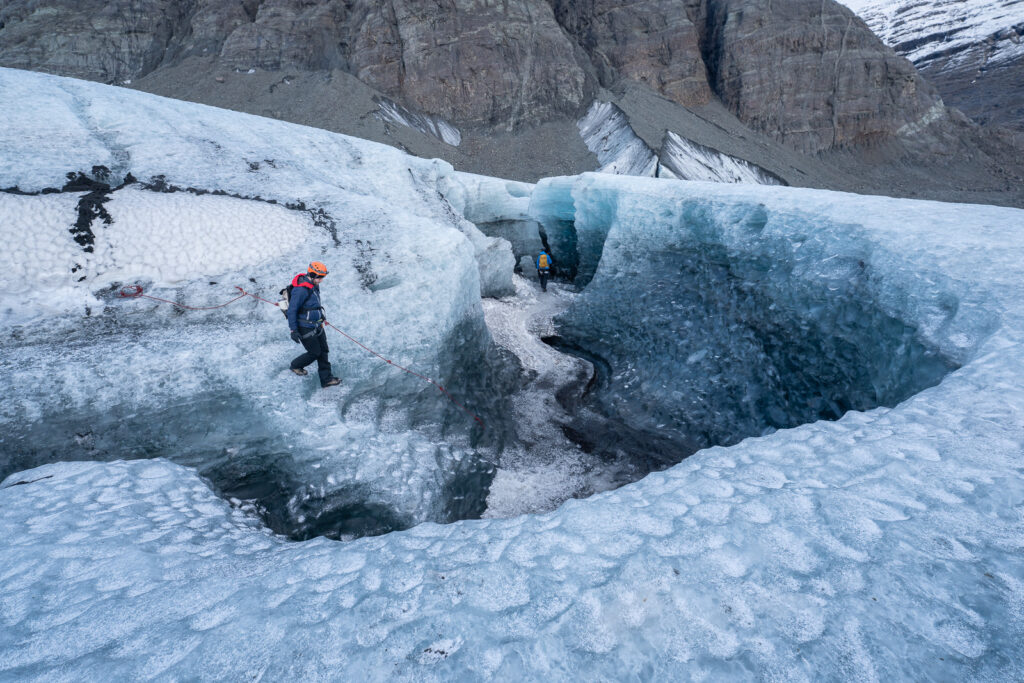
In some areas, there are ropes to indicate where to walk, but in all cases your guide clearly tells you which zones are more or less dangerous and where to place your feet.
A small-group glacier tour
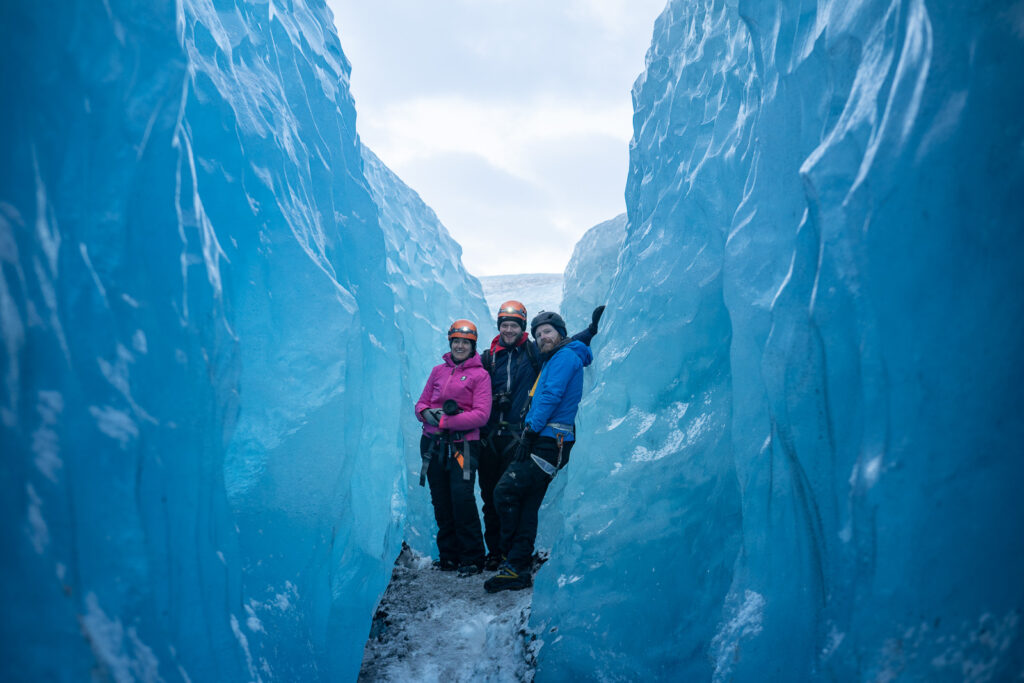
The fact we were a small group made a huge difference. We were four (Matthias, two friends and I), plus our guide Dan. We were able to take our time, without pressure, ask lots of questions, and most importantly stop whenever the light became interesting. I genuinely think patience must be the number one requirement to be a glacier guide because we literally stopped every two meters to take photos, and Dan gave us all the time we needed (he even posed for us).
I can’t compare this with larger tours since I haven’t done one, but we did cross paths with a single group of around 15 people. Honestly, I think the experience must be much less enjoyable as they were all walking in a single line. I was a bit worried before the tour that we would be surrounded by crowds, because I know that glacier tours are very popular in Iceland, but apart from that one group we were completely alone the entire afternoon.
I really think that being in a small group is what makes the experience so immersive, you don’t “consume” the glacier, you take time to discover it. And for photography, the difference is huge : no lines of people in your frame, no feeling of rushing, we could take our time to compose and truly enjoy the moment. It was absolutely magical !
How a glacier tour works
Getting equipped and approaching the glacier
We meet Local Guide at the parking lot of Jökulsárlón, at the meeting point indicated in the confirmation email you receive when booking. It’s honestly hard to miss, their truck is clearly indicated in large orange letters at the meeting point ☺️
A guide helps you fit your crampons and checks that you’re wearing suitable shoes for walking on the glacier. If not, you can rent proper shoes on site. The most important thing is to have sturdy hiking boots with good ankle support. If you want to know exactly how to pack for Iceland in winter, I’ve detailed everything in a dedicated article, with photos and links. You don’t need to bring crampons, once again they provide them.
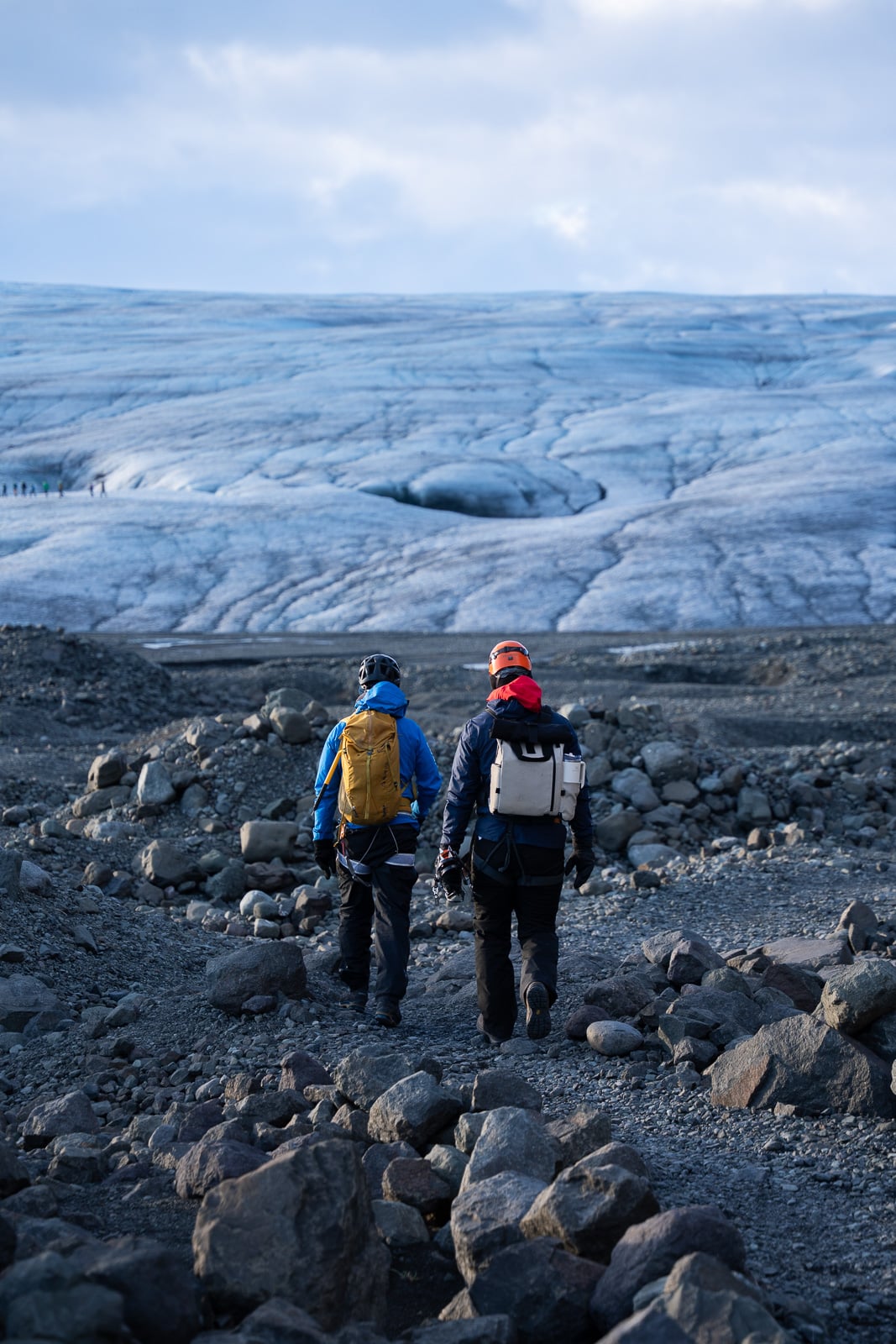
Once the crampons are adjusted to your shoe size, they help you put on a harness, you’re assigned to your glacier guide and you hop on a 4×4. There is about a 30-minute drive to reach the glacier parking area. Once you arrive, they give you a helmet, you’ll put the crampons on later. All the safety equipment is provided, and the guide explains how to wear everything properly. There is a small walk to the glacier, in 2026, the approach hike takes about 30 minutes from the parking lot to the foot of the glacier. Some other years, it can be shorter or longer, it really depends on how far the glacier has retreated during the season you’re visiting Iceland.
The first steps on ice
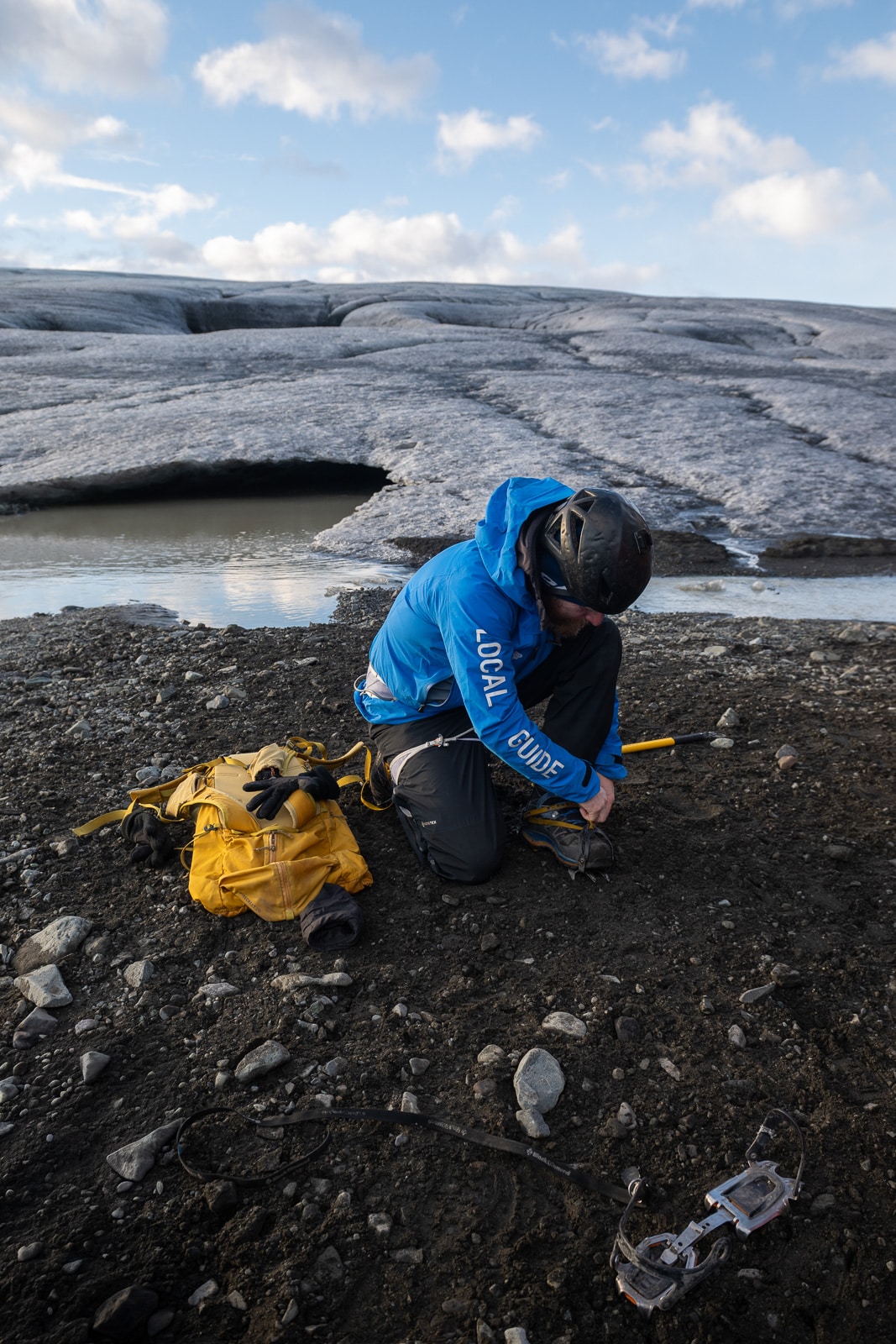
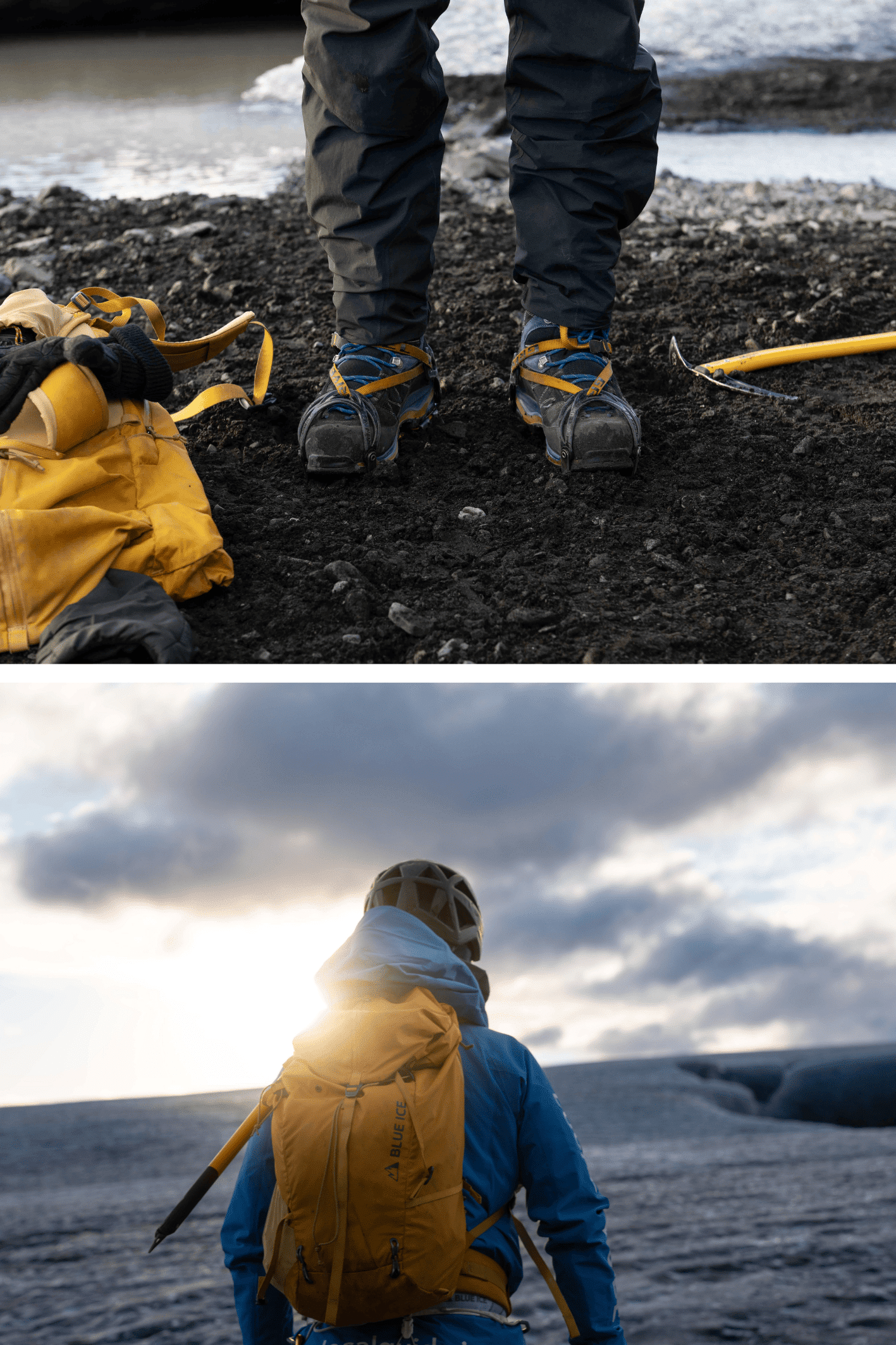
When you reach the foot of the glacier, it’s time to put on your crampons. Your guide explains exactly how to do it, so even if you’ve never worn crampons in your life, the process is gradual and stress-free. Dan took the time to check everybody’s shoes, answer questions and make sure everyone felt comfortable before moving on. This is also when you start to understand why each piece of equipment is essential. The guide goes over a few basic safety rules and then it’s finally time to step onto the glacier.
Very honestly, the first steps on the ice feel a bit strange, but that feeling fades quickly. I didn’t notice a huge difference between walking with crampons and walking in slightly bulky hiking boots. You quickly forget about the crampons because you’re completely absorbed by your first sensations on the ice : the sound of metal biting into the glacier, the texture below your feet, the subtle shades of blue and grey. Everything is already beautiful, even before seeing features like ice caves or moulins.
Walking on a glacier for an entire afternoon
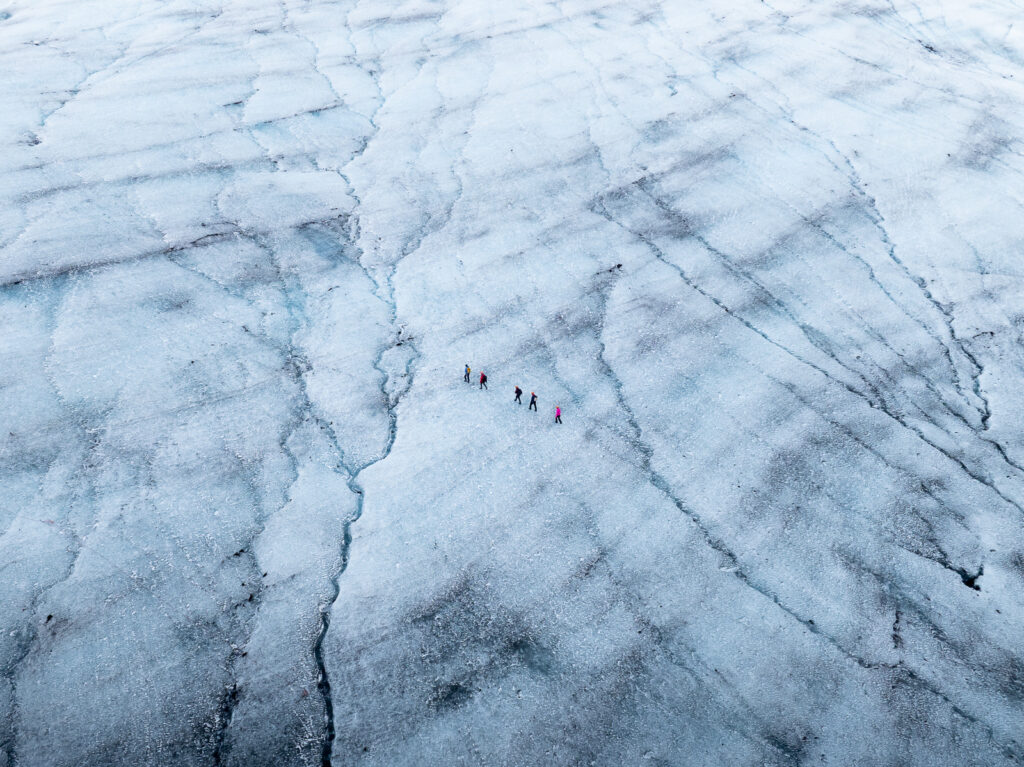
We spent the entire afternoon on the glacier, from 2.30PM to 5PM, right until sunset. We alternated between walking and exploring different glacier formations : moulins, ice tunnels, small waterfalls, crevasses… all signs that tell the story of the glacier, if you take the time to observe them. I’ll let the photos speak for themselves, describing the experience is nice but showing it will say more than words would express.
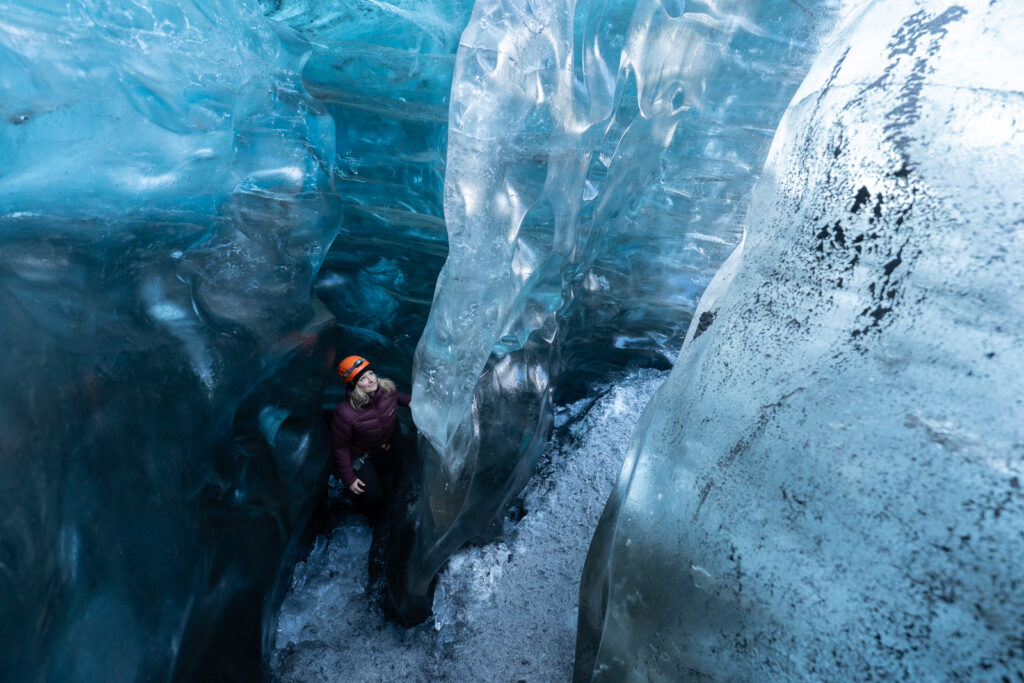
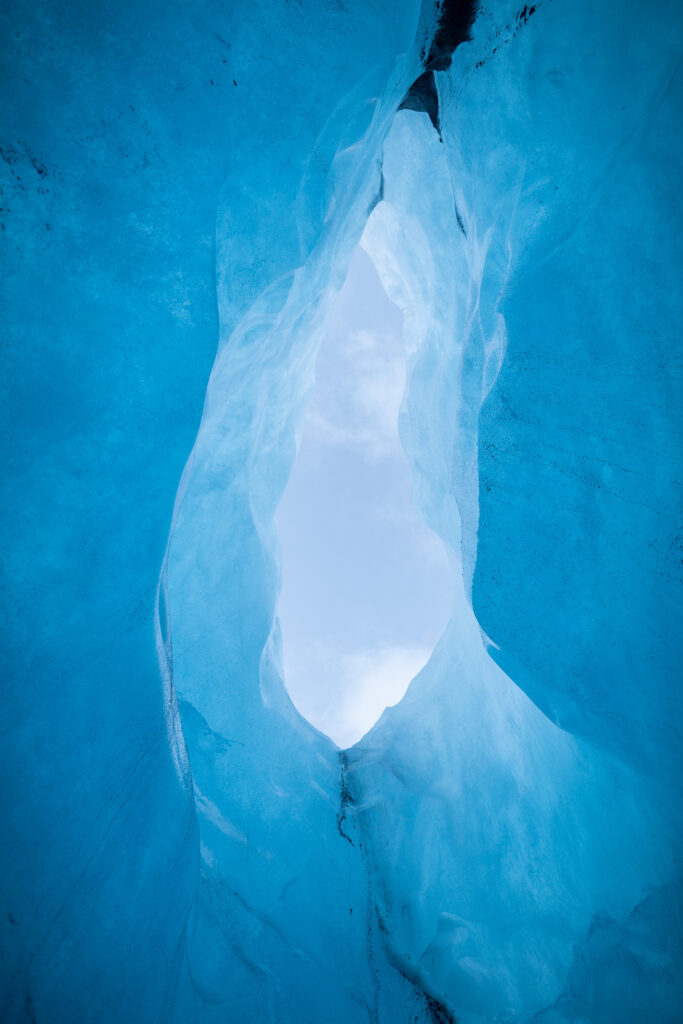
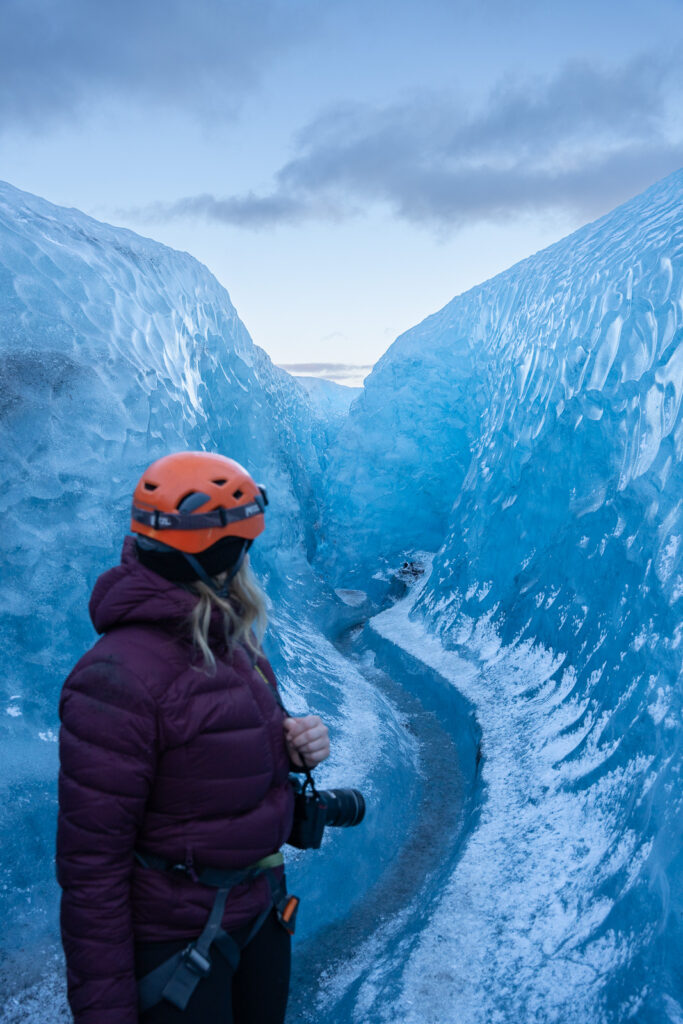
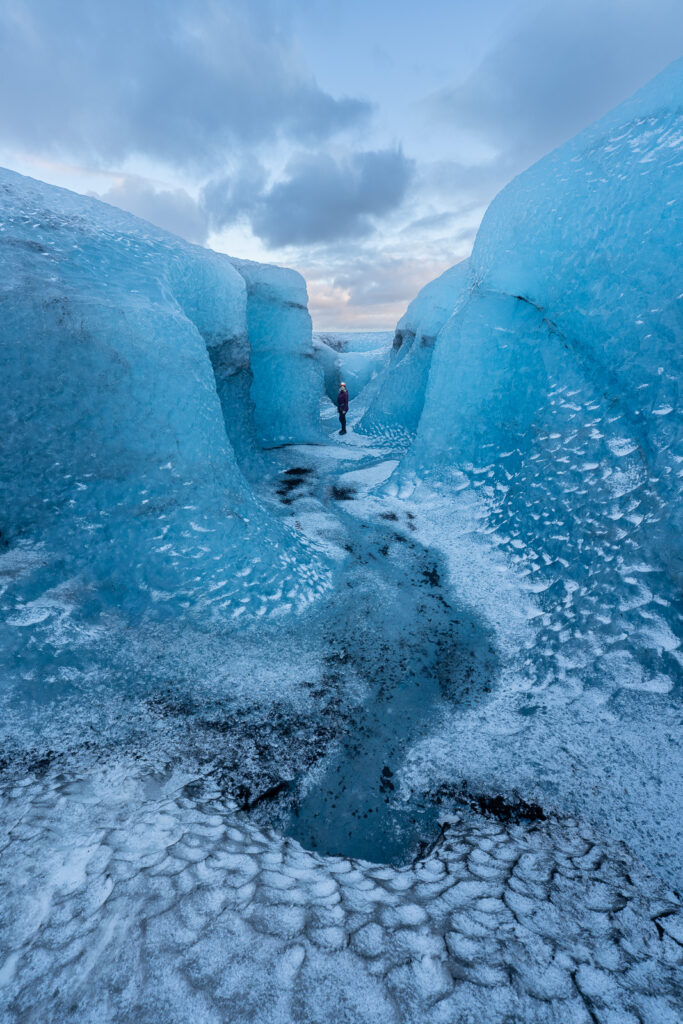
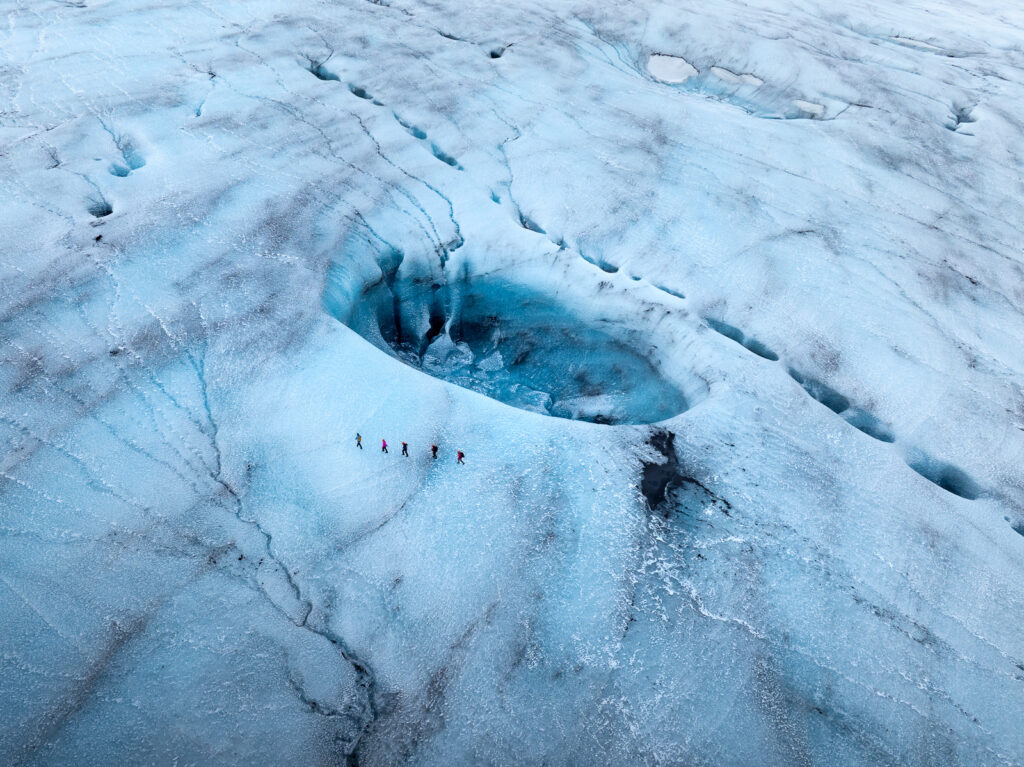
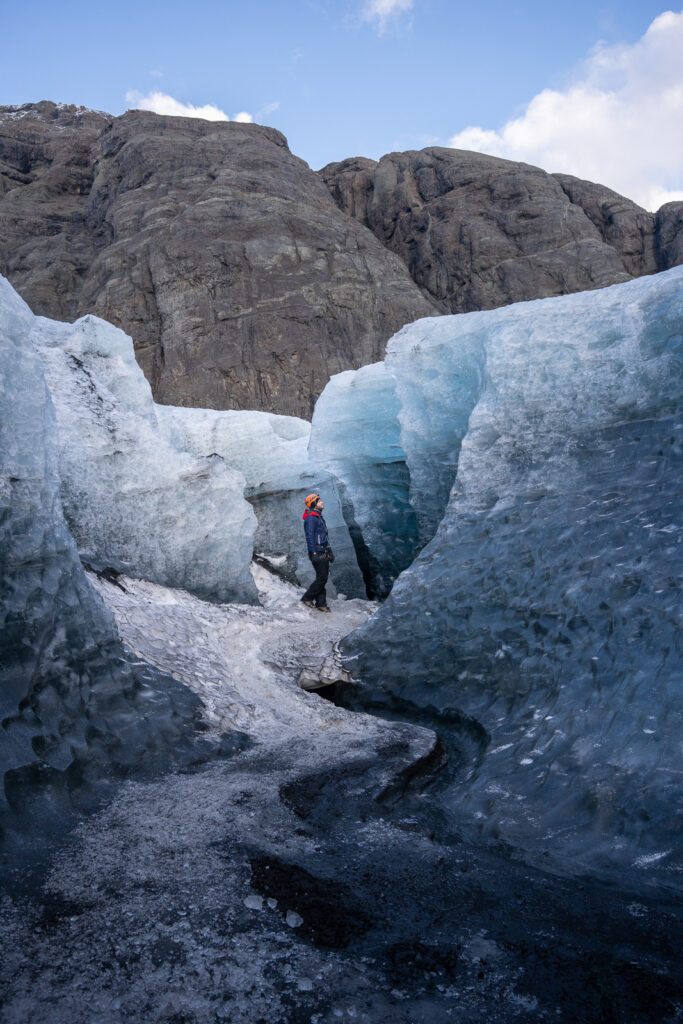
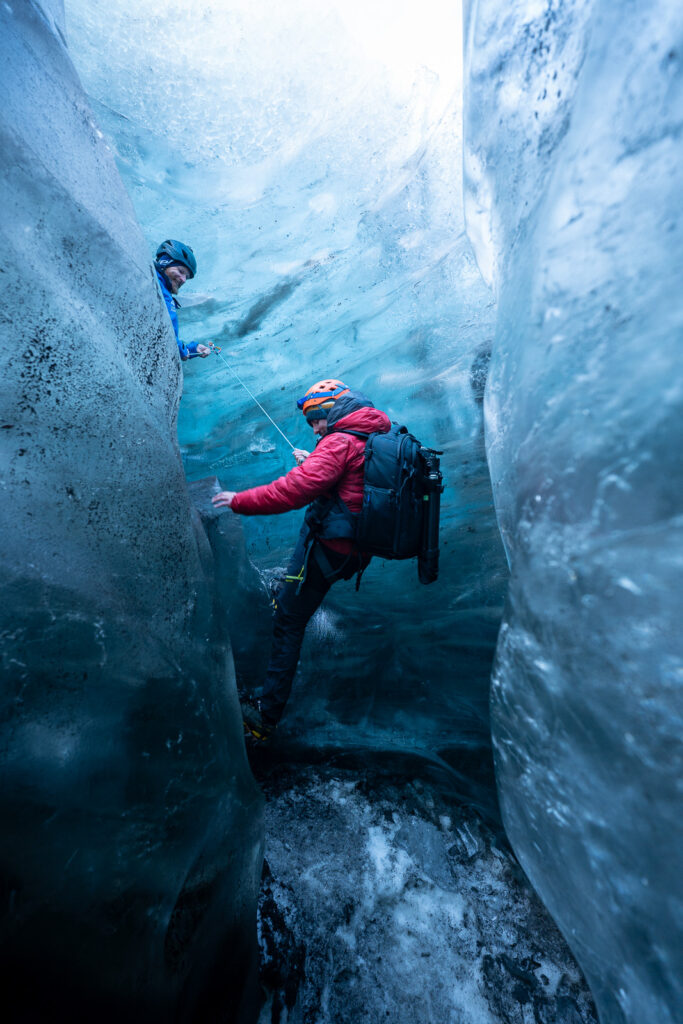
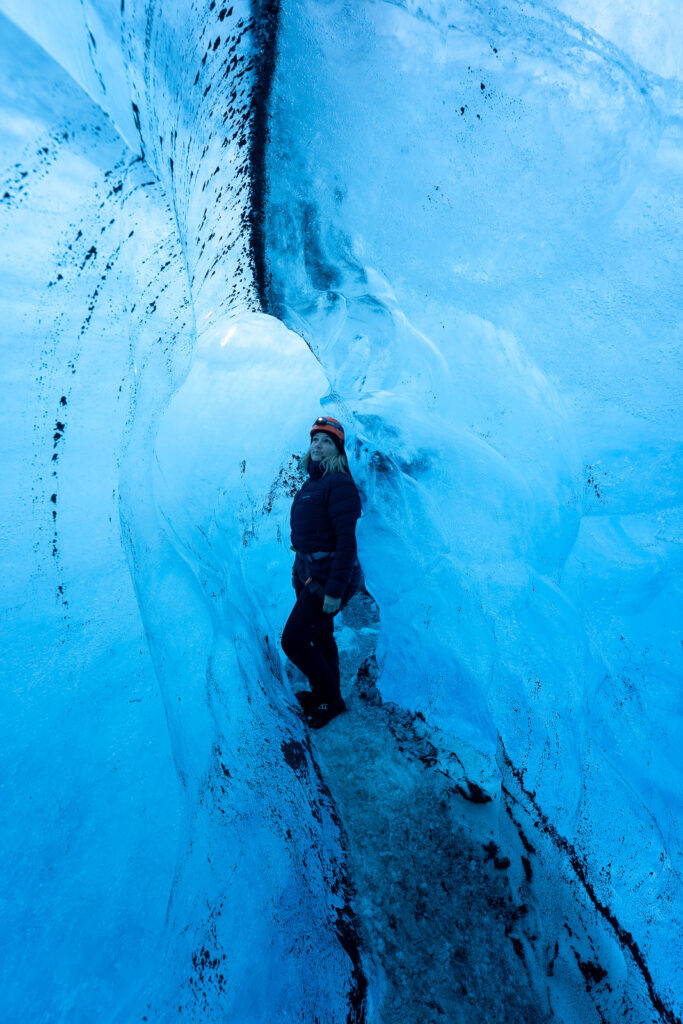
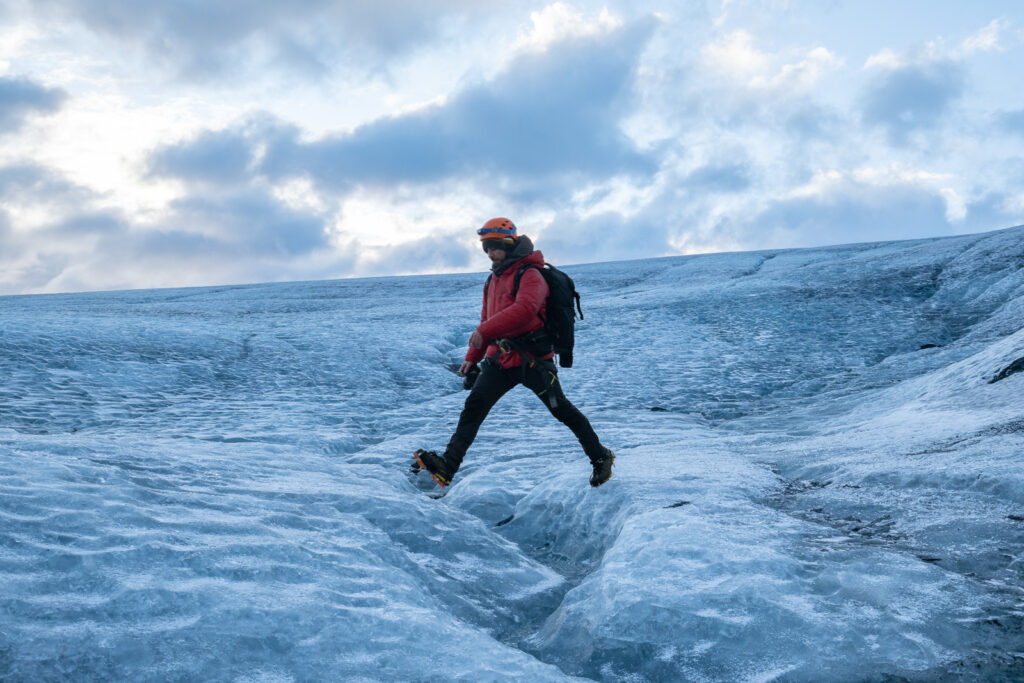
We did NOT explore an ice cave during this tour, as we had already done it the day before. In winter 2026, there were only a few different caves accessible on the glacier. We also discussed our expectations before starting the hike and Dan asked if we had already been on a glacier. Since we had visited and photographed the ABC ice cave the day before (article coming soon !), he decided to take us onto the glacier itself to avoid repeating the same experience. It was really great to be able to “customize” the tour like this and not simply do the same thing again that we did with a different company.
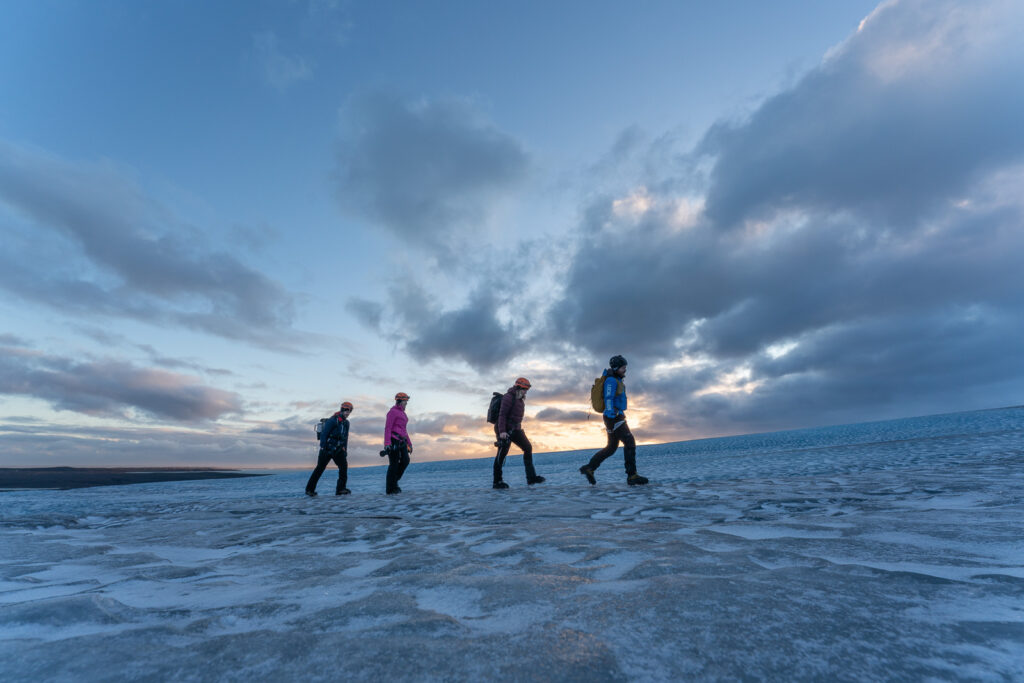
We ended the day with a sunset on the glacier, it felt surreal. We were incredibly lucky with the weather that day : clear skies and a few small clouds throughout the day. On a glacier, the light changes constantly. When the sun goes down, shadows stretch out and colors soften in a beautiful way.
End of the tour and return
After the hike, it’s the same process in reverse : once back at the foot of the glacier, you remove your crampons, then a 30-minute walk back to the vehicle. At the car, you take off your harness and helmet, followed by another 30-minute drive back to Jökulsárlón. We returned to the hotel (which we had booked close to the area, it was perfect, only 10 minutes from Jökulsárlón). The fatigue really kicks in after several hours walking on ice, but it’s a “good” kind of tired, the kind that comes from walking, observing, taking your time (and filling up SD cards). We slept very well that night and very early 😅
Do I recommend Local Guide for a glacier tour ?
YES, YES, YES and a hundred times YES !! If you’re looking for a small-group experience, you enjoy taking your time, and you’re sensitive to a respectful and educational approach, I 100% recommend it. The thing I liked the most was being in a small group. Obviously, we had booked a private photo tour, but my friends also did a “classic” tour and were eight people with one guide, which is still quite intimate.
Before booking, keep in mind that weather conditions and the state of the glacier will dictate many aspects of the experience. Visible formations vary, ice caves evolve, and that’s exactly what makes every tour unique. Your guide will always decide what is safe or not during the tour and where to go.
👉 Glacier/ice caves tours range from 115€ to 250€ ; a personalized private tour is tailored to your desires and the amount of people so you’ll need to ask Local Guide through their form for an estimate of the price. In any case, because this is still a fairly expensive activity, I asked the company whether it would be possible to offer you a discount. Sooooo if you would like to book a glacier activity with Local Guide, you can get 10% off all glacier tours by using the code “ROAMWITHMARIE” when booking. Enjoy !
Final thoughts on the glacier experience
Walking on a glacier in Iceland is an incredible experience and that’s exactly why it deserves to be done in the right conditions with the right people. This tour reminded me that a glacier is definitely not an amusement park and that in Iceland more than anywhere else, you truly feel small in front of nature. Glaciers are fragile environments, constantly evolving and they should be discovered slowly and respectfully. Taking the time, understanding what you’re seeing, listening to someone who truly knows the terrain completely changes your experience.
If you’re looking for more than just a walk on the ice, and you want to come back not only with beautiful photos but also with a real understanding of what’s happening below your feet, then a small-group guided glacier tour like the one offered by Local Guide is absolutely perfect.
Have an amazing trip to Iceland 🇮🇸
Marie